Test one thing at a time
A test only teaches you something when one variable changes. If two videos differ in creator, hook, length and offer, a winner tells you nothing you can reuse.
TikTok's split testing tool is a good model of the discipline. It divides the audience into two equal groups, shows each group one version, and only declares a winner when the result is statistically significant, using a 90% confidence level (TikTok: About Split Testing). Creative is one of the variables it lets you test. Even if you don't use a formal split test, borrow the idea: hold everything else still.
Hooks first, then angles, then formats
Test in layers, cheapest change first.
| Layer | What changes | What stays the same | Read this first |
|---|---|---|---|
| Hook | The first two or three seconds | The rest of the video | Hook rate |
| Angle | The core message or problem | Product, offer, format | Hold rate, then cost per result |
| Creator or format | Who's on camera, length, style | Message and offer | ROAS over a longer window |
Hooks come first because they're the cheapest variable to produce and the one that decides whether anything else gets watched. One good video with three different openings gives you three test assets from a single shoot.
How to size a batch
Think in concepts times variations, not in raw video counts.
- A concept is a distinct idea: a problem, a demo, a comparison, a routine.
- A variation is a different hook or cut of the same concept.
Three concepts with three hooks each gives you nine test assets. That's enough to learn which ideas work and which openings carry them, without spreading budget so thin that nothing gets a fair read.
With flat per-video pricing, a batch has a known cost before you start. At Ad Army, a 30 second edit is $175 and includes three hook variations, so the nine-asset plan above is three videos and $525. For reference, the cost of a batch at our list prices:
| Batch | 15 second edits ($125) | 30 second edits ($175) | 60 second + raw ($260) |
|---|---|---|---|
| 5 videos | $625 | $875 | $1,300 |
| 10 videos | $1,250 | $1,750 | $2,600 |
| 20 videos | $2,500 | $3,500 | $5,200 |
You only pay for videos you approve, so the batch cost is a ceiling, not a guess.
Spot a video wearing out
Every ad loses steam as the same people see it again. There is no fixed number of days for this; it depends on your audience size, budget and how often the video is shown. Watch the signals instead.
- Frequency climbs while results flatten.
- Hook rate drops on the same audience, meaning people who've seen it scroll past.
- Cost per result rises week over week with no change in targeting or offer.
When two of these move together, the video is wearing out. That's the moment to rotate in a new hook on the same concept before you replace the concept itself.
Read results per video, not per ad set
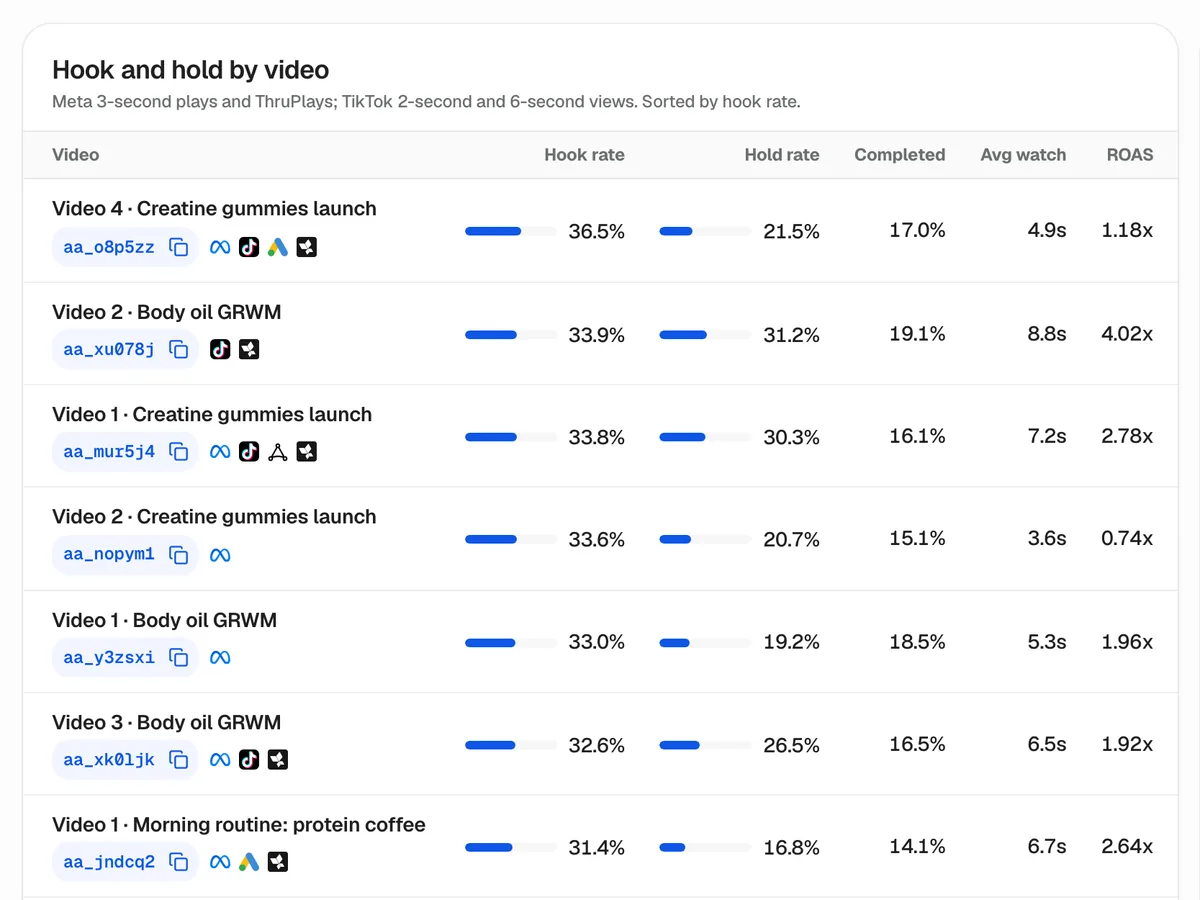
When one video runs in several ad sets, its results get split up and the winner can hide. Roll results up by video, compare under one attribution rule, and keep a simple log:
- Video and concept name
- Hook variation tested
- Hook rate and hold rate
- Spend, attributed sales and ROAS
- Decision: scale, iterate the hook, or retire
Our guide to tracking sales by creator video covers the setup.
 (opens the full-size image in a new tab)
A cadence that keeps the pipeline full
- Launch a batch of new concepts with several hooks each.
- After each test has had a fair read, cut the losers and move budget to the winners.
- Order new hook variations for the winning concepts.
- Start the next batch of new concepts before the current winners show the wear signals above.
How Ad Army fits a testing program
Flat prices make batches easy to budget, and because we take 0% of your ad spend, scaling a winner never raises our fee. Every approved video has its own tracking code and shows its hook rate, hold rate and ROAS, so the winners are visible per video. When you're ready to launch, the ad builder sends approved videos to Meta as tracked ads.