Why paid UGC ends up unusable
When a batch of creator videos comes back wrong, the creator is rarely the whole story. The same few gaps show up again and again.
- The brief described a feeling, not a video. "Fun, authentic, Gen Z" can be filmed a hundred ways. The creator picked one, and it wasn't yours.
- Nobody said what the video must claim. The creator guessed at the benefit, or worse, made a claim you can't support.
- Feedback arrived as a reaction. "Not quite it" gives a creator nothing to change, so the second cut misses too.
- Payment came first. Once a creator is paid on delivery, a revision is a favor. Some will do it gladly. Some won't.
You can fix each of these before filming starts.
Write a brief that can't be misread
A good UGC brief is short, but it answers every question the creator would otherwise answer for you. Use this as a checklist.
- The one message the video must land, written in your words.
- Claims the creator must never make (health results, prices that change, comparisons you can't prove).
- Hook direction: what the first two or three seconds should show or say.
- Length and format: 15, 30 or 60 seconds, vertical, captions burned in or not.
- Must-show moments: product in hand, the label, the result, the app screen.
- Brand no-gos: competitor products in frame, certain words, certain music.
- Where it will run: organic, paid, or both, so framing and text placement fit.
- One or two reference videos, with a note on what you like about each.
The claims line matters more than it looks. The FTC says advertisers can be held responsible for what endorsers say on their behalf, and that brands should explain which claims are allowed (FTC Endorsement Guides FAQ). Writing the allowed claims into the brief protects you and gives the creator a clear lane.
Agree on how revisions work before anything is filmed
Most disputes about "unusable" videos are really disputes about revisions. Settle these points in writing before production:
- How many rounds of changes are included, or whether changes continue until you approve.
- What counts as a revision (a trim, a new caption, a different hook) and what counts as a reshoot.
- How notes are given: in one place, tied to timestamps, from one decision maker.
- What happens if a video still misses after a reasonable number of rounds.
The quality of your notes decides the quality of the next cut. Compare these.
| Vague note | Note that gets a fix |
|---|---|
| "The energy feels off." | "Cut the first two seconds and open on the before shot." |
| "Can it be more on-brand?" | "Use white captions with no emoji, like the reference video." |
| "Not sure about the hook." | "Open with the question from line 3 of the script." |
| "Make it shorter." | "Trim to 15 seconds. Keep 0:00 to 0:06 and the close-up at 0:18." |
If your provider lets you leave notes directly on the frame, use it.
Tie payment to approval
When you pay changes who carries the risk of a miss.
| Payment model | When you pay | What an off-brief video costs you |
|---|---|---|
| Upfront | Before filming | The full fee, plus your time to recast |
| On delivery | When the files arrive | The full fee, unless the creator agrees to rework it |
| On approval | When you accept the final cut | Another round of notes; nothing for a cut you never accept |
Creators you hire directly often ask for payment upfront, because they carry the cost of filming. If you go that route, put the revision terms in the contract so a miss has a remedy. If you can choose, approval-based pricing puts the incentive where it belongs: the producer only gets paid when the video is right.
What to check before you approve
Approval is the moment the video becomes yours to run, so give it a proper pass.
- The first frame works with the sound off.
- Captions match the audio word for word, and the product name is spelled right.
- Every claim is one you can support.
- Prices, offers and dates are current, or left out.
- Hook variations are labeled so you can test them separately.
- If the video will run from the creator's handle or appear on their feed, the paid relationship is disclosed in the video itself. The FTC's guidance for influencers says the disclosure should be hard to miss and not only in the description (FTC Disclosures 101).
How Ad Army handles it
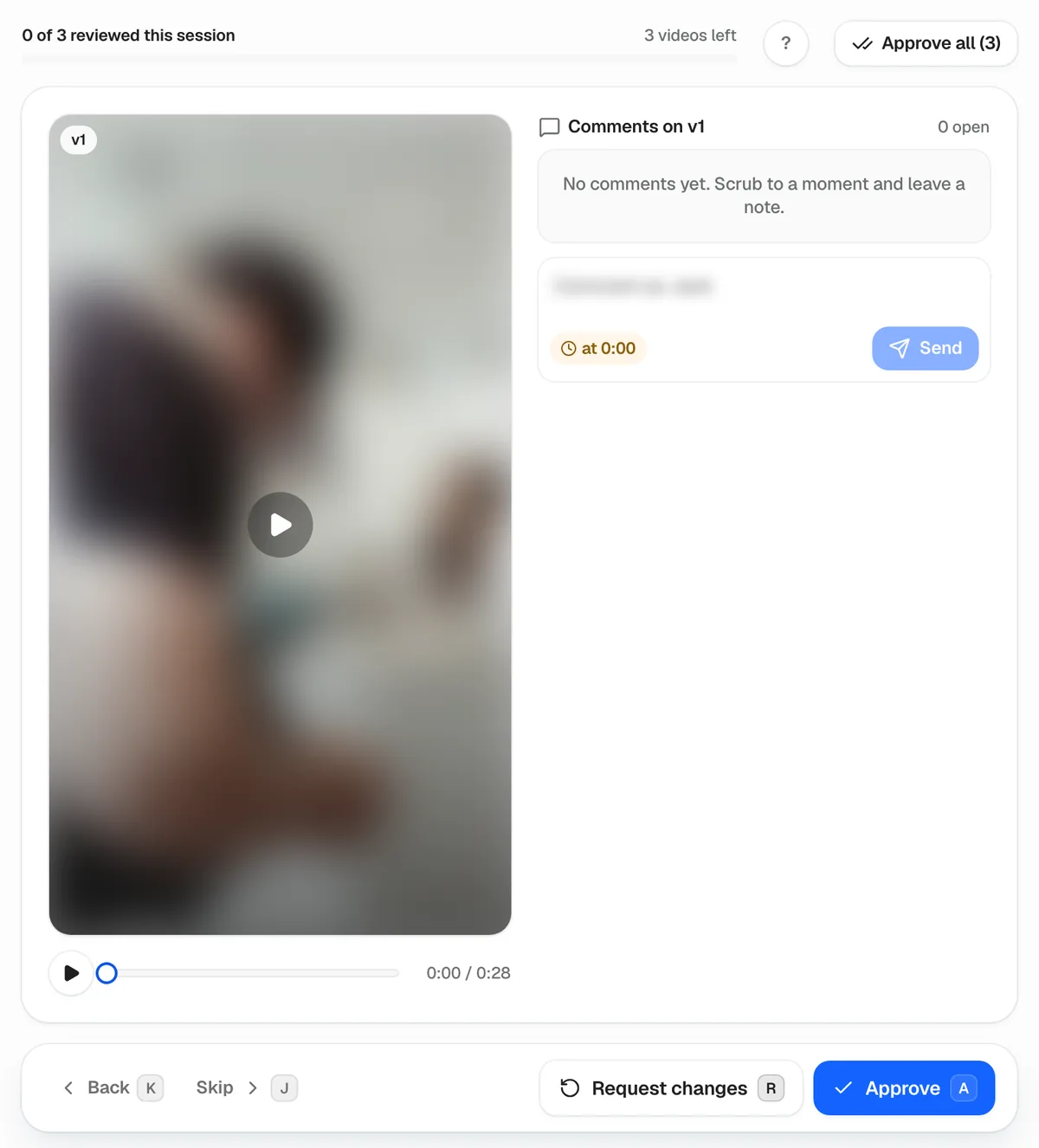
At Ad Army, nothing is charged when you place a request. When a video comes back, you leave timestamped notes right on the frame, and revisions continue until the video is approved. Each video is billed to your card only when you approve it, at a flat price: $125 for a 15 second edit, $175 for a 30 second edit with three hook variations, and $260 for a 60 second edit plus raw footage. A cut you never approve is a cut you never pay for. Full prices are on the pricing page.
 (opens the full-size image in a new tab)