Why creators miss deadlines or disappear
It helps to start from the creator's side. Many UGC creators are freelancers juggling several brands, and the work that slips is the work with the weakest commitment attached.
- No written deadline. "Sometime next week" loses to a client with a date.
- A brief they don't understand. Confused creators stall instead of asking.
- Payment that's already done, or never coming. Fully prepaid work has no pull to finish. Gifted product with no fee has even less.
- Overbooking. A creator who said yes to everything can't deliver everything.
- Life. Illness, moves and family events happen. A good process plans for them instead of hoping.
None of this makes the creator a bad actor. It does mean that relying on goodwill alone is a plan to be disappointed sometimes.
Why gifting alone is the riskiest deal
Sending free product in exchange for "a video if you like it" is popular because it looks cheap. It is also the arrangement where you have the least say. There is no deliverable, no date and no remedy if nothing comes back.
Free product still counts as a relationship that needs disclosing. The FTC tells influencers to disclose any financial relationship with a brand, and that includes free or discounted products (FTC Disclosures 101). So a gifted post that does go live should still carry a disclosure, which is one more thing you can't control without an agreement.
If you want a video you can rely on, treat it as an order, not a gift.
A simple process that cuts no-shows
You don't need heavy tooling. You need the same few steps every time.
- Confirm availability and a delivery date before you ship anything. A creator who can't commit to a date now won't hit one later.
- Put it in writing. One page covers it: deliverables, length and format, deadline, revision terms, usage rights and when payment happens.
- Stage the payment. A deposit to start and the balance on approval keeps both sides invested.
- Check in once at the midpoint. Ask for a rough cut or a few raw clips. Silence at this point is your early warning.
- Keep a backup for every slot. If a creator goes quiet, you recast without restarting the search.
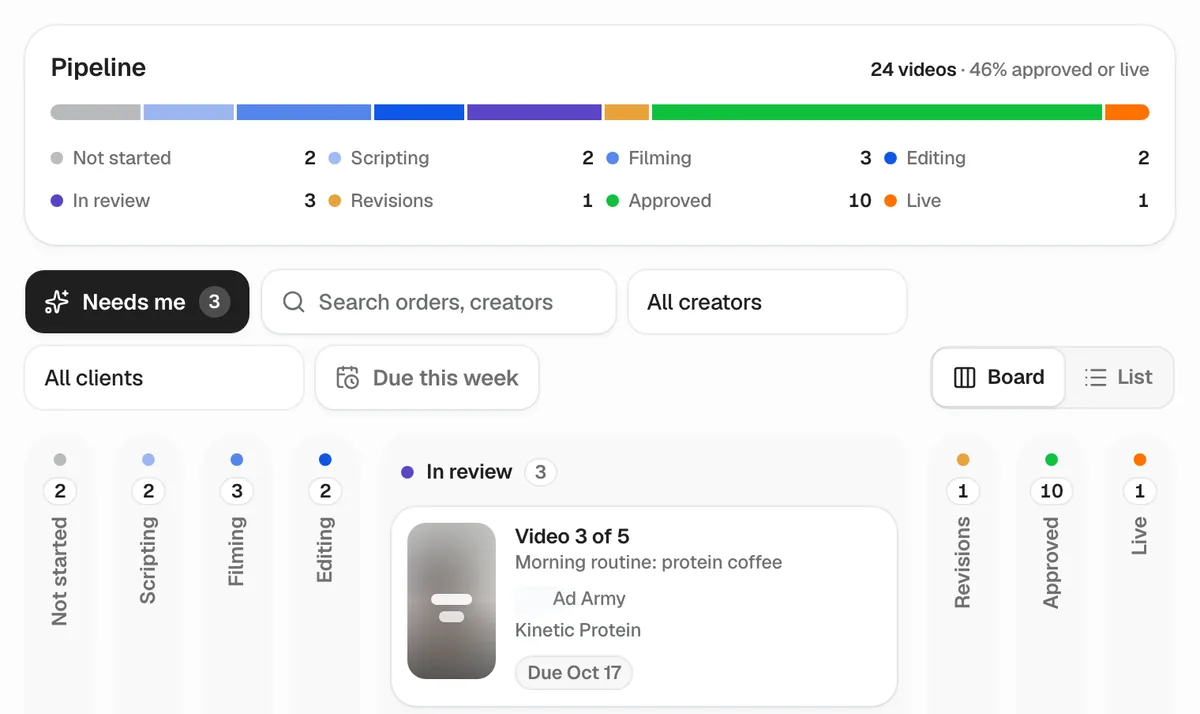
- Track every creator in one place. Status, dates, files and payment, in one sheet or tool, so nothing depends on memory.
If a creator has already gone quiet
Give it one clear, polite message with a date: "Can you confirm you'll deliver by Friday? If not, we'll need to recast." Then stop waiting.
- Check your agreement for what happens to any deposit or product if the deadline passes.
- Move to your backup creator the day after the date you named, not a week later.
- Keep the conversation in writing and professional. A creator who had a real emergency may be worth working with again.
- Note what happened in your tracker, so the next booking decision is based on a record, not a feeling.
Who carries the risk under each setup
| Setup | What you manage | If a creator goes quiet |
|---|---|---|
| Gifting only | Outreach, shipping, follow-ups | You lose the product and the time; there is no remedy |
| Direct paid deal | Sourcing, contract, payments, follow-ups | You enforce the contract yourself and recast |
| Self-serve marketplace | Picking creators, briefs, reviews, often follow-ups | Depends on the platform's terms; read them before you rely on them |
| Managed service | Your request and your review | The provider handles creator communication |
The more of the creator relationship you hold, the more of the chasing you do.
How to vet for reliability, not just style
When you do hire directly, look past the portfolio.
- How fast and clearly did they reply to your first message?
- Did they ask questions about the brief, or just say yes?
- Can they show work delivered for other brands, on a deadline?
- Will they do a short paid test before a larger batch?
- Are their rates and revision terms written down?
What a managed service changes
With a managed service, you don't hold creator relationships at all. That is the trade: less control over who appears, much less work keeping production moving.
At Ad Army, you submit a request and we cast it from our own roster of vetted creators, each reviewed on camera before they're cast. We brief them, contract them and pay them. You never send a DM or a follow-up. You see finished videos in your review thread, leave notes, and approve what's right. Creators stay anonymous to brands, so you choose on the work, not on a profile.
Production delays can still happen with any provider. The difference is who deals with them. With a managed service, creator communication is our job, not yours.
 (opens the full-size image in a new tab)