Who owns a UGC video by default
Start with the default, because it surprises a lot of brands. The U.S. Copyright Office explains that a work is "made for hire" in two situations: when an employee creates it as part of their job, or when a commissioned work falls into one of nine specific categories and both sides sign a written agreement that expressly calls it a work made for hire (Copyright Office Circular 30). If any requirement is missing, it is not a work made for hire.
A UGC creator is usually a freelancer, not your employee. So unless your agreement handles ownership properly, the creator may keep the copyright and you get whatever permission the agreement grants. That permission is the license, and its terms decide what you can do.
Whether a particular agreement transfers ownership, or which category a video falls into, is a question for a lawyer. What you can do yourself is read the license you have.
The five terms that define your license
| Term | What it controls | Watch out for |
|---|---|---|
| Channels | Organic social, paid ads, website, email, TV | "Organic only" licenses that don't cover paid ads |
| Duration | How long you can keep using the video | Fixed windows that end while the ad still runs |
| Territory | Where in the world it can run | Country limits on a campaign that later expands |
| Edits | Whether you can cut, resize, re-caption or add hooks | Licenses that cover the original file only |
| Exclusivity | Whether the creator can make similar videos for others | A separate term; don't assume it's included |
If your agreement is silent on one of these, don't read the silence as permission. Ask, and get the answer in writing.
What expired rights look like in practice
Rights problems rarely look dramatic. They look like ordinary marketing.
- An ad that was set up when the license began is still running months after the window closed.
- A video licensed for organic posting gets boosted or dropped into a paid campaign.
- Someone cuts a new hook from an old video, and the license only covered the original.
- An agency reuses a creator video for a second client, or a client keeps running it after the agency relationship ends.
Each of these is easy to do by accident, especially when the people running ads never saw the creator agreement.
Audit the ads you're running now
A rights audit takes an afternoon and is worth repeating every quarter.
- Export every active ad that uses creator content, across every ad account.
- Match each video to its creator agreement. Flag any you can't find.
- For each, note the channels, the end date, the territory and the edit rights.
- Flag anything past its end date or running outside its licensed channels, and consider pausing it until the license is sorted out with the creator or your counsel.
- Put license end dates in a shared calendar with a reminder a few weeks early.
- Store agreements next to the video files, so whoever builds the next ad can check.
Usage rights are not whitelisting
These get mixed up constantly. Usage rights cover your use of the video from your own accounts. Whitelisting, TikTok Spark Ads and Meta partnership ads let you run ads from the creator's account, under their name and handle. That uses their identity, so it needs their permission even when you hold broad rights to the video. TikTok, for example, describes Spark Ads using other creators' posts only with their authorization (TikTok: About Spark Ads). We cover that in whitelisting and Spark Ads for UGC.
How Ad Army handles rights
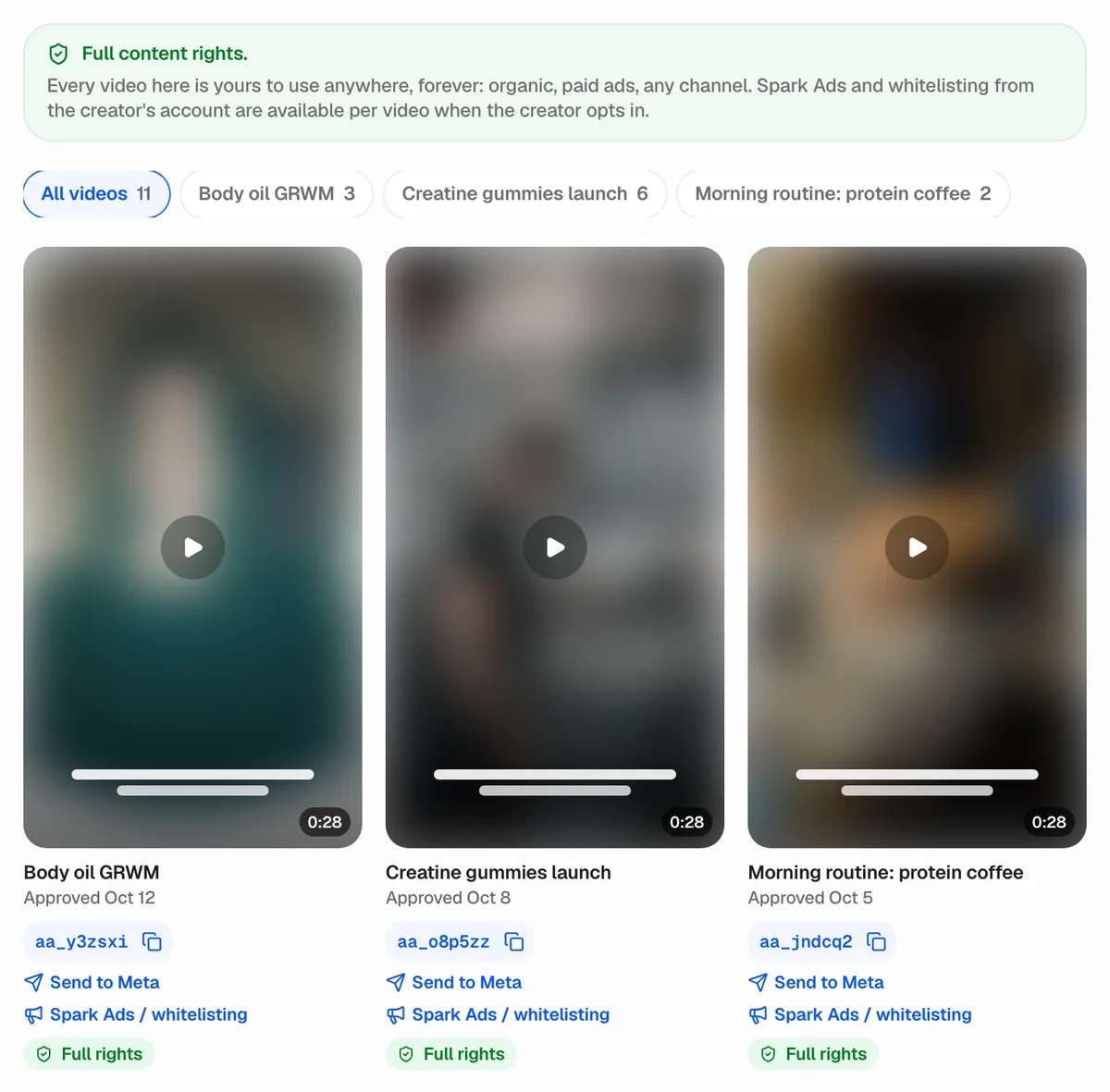
Every video you approve at Ad Army comes with full content rights: organic social, paid ads, your website and landing pages, email, CTV and any other placement from your own ad account, worldwide, with no expiry. Trims, resizes, re-captions and cut-downs are covered too. Rights start when you approve the video and are included in the flat price, so there is no window to track and no renewal invoice. When an agency orders for a client, the rights extend to the brand the video was made for. Running ads from a creator's own account is separate and available per video when the creator opts in. You can read the full terms in the content rights license.
 (opens the full-size image in a new tab)
This article is general information, not legal advice. For a specific agreement, talk to a lawyer.