What whitelisting actually means
"Whitelisting" is the industry's catch-all word for running paid ads through a creator's identity. Each platform has its own version and its own name.
| Term | Where | What it does |
|---|---|---|
| Whitelisting | Industry shorthand | Any setup where a brand runs ads that appear to come from a creator |
| Spark Ads | TikTok | Turns an organic TikTok post into an ad; posts from other creators need their authorization |
| Partnership ads | Meta (Facebook, Instagram) | Ads that show the creator and the brand together, with the creator's permission |
TikTok's help center describes Spark Ads as a format that uses organic posts in ads, and says posts from other creators can be used with their authorization through a code whose duration can be set to fit the campaign (TikTok: About Spark Ads). TikTok also notes that views, likes, comments and follows from the ad count toward the original post. For Meta's current permission steps, check Meta's Business Help Center, since its menus change often.
Why it costs extra
Running an ad from your brand account uses your name. Running it from a creator's account uses theirs. That's the whole reason it's priced separately.
- The ad appears under the creator's handle, to people who may never have seen their feed.
- On TikTok, engagement from the ad lands on their original post.
- Their name is now attached to your offer, your claims and your comment section.
A creator taking on that exposure is reasonable to charge for it, and reasonable to say no. Treat permission as something you earn per video, not something your content license already gives you. Usage rights and whitelisting are different things, which we explain in UGC usage rights explained.
Why getting a yes takes so long
The cost is often the smaller problem. The bigger one is the back and forth.
- The request arrives with no context, so the creator has to ask what it's for.
- The ask is open-ended ("can we whitelist you?") instead of one video, one period.
- The creator has to generate a code or approve a request in an app they rarely open for brand work.
- Codes and permissions expire, so a campaign that runs longer needs a second ask.
How to ask so creators say yes faster
- Ask for one specific video. Link it, and say which platform.
- Say how long and where. "Paid ads on TikTok for 60 days" is easy to say yes to. "Ongoing" is not.
- State the fee upfront, and when it's paid.
- Explain what they'll see. On TikTok, engagement from the ad will show on their post.
- Send the exact steps to generate the code or accept the request.
- Confirm in writing once they've agreed, with the end date.
Don't skip the disclosure
An ad running from a creator's handle is still a paid relationship. The FTC tells influencers to disclose any financial relationship with a brand, to make the disclosure hard to miss, and to put it in the video itself rather than only the description. It also says platform disclosure tools can be used, but advises adding a clear, plain disclosure such as "ad" as well (FTC Disclosures 101). Use the platform's paid partnership label together with a clear disclosure, and follow its rules.
When it's worth paying for
| Item | Run from your brand account | Run from the creator's account |
|---|---|---|
| Permission needed | Covered by your content rights | The creator's yes, for each video |
| Extra cost | None | Usually a fee per video or per period |
| Whose name is on the ad | Yours | The creator's (with your brand on partnership ads) |
| Where engagement goes | Your ad | On TikTok, the creator's original post |
| Control | Full | Ends when the permission ends |
Whether creator-handle ads outperform your own account for your product is something to test, not assume. A sensible approach is to launch from your own account first, find the videos that work, and pay for whitelisting on the winners.
How Ad Army handles it
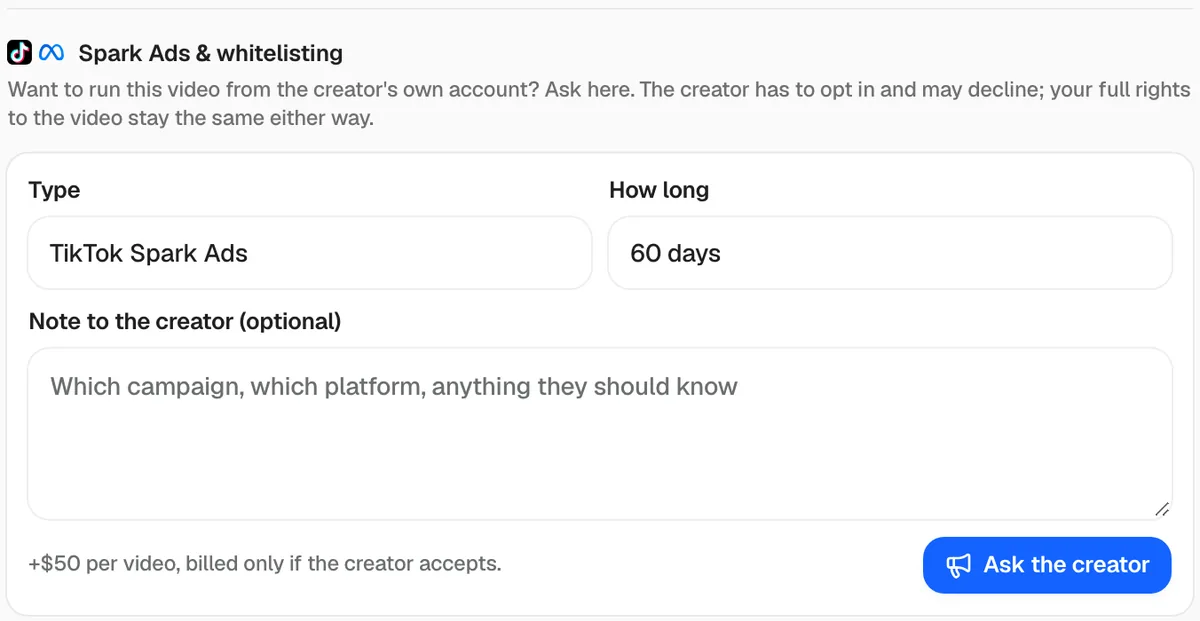
Running any approved Ad Army video from your own ad account is always included. If you want Spark Ads or whitelisting, you ask from the approved video, and we take the request to the creator. It still needs the creator's yes, so it's never automatic. If they accept, you get their handle and the Spark code for that video only, and you pay a flat $50 for that video. If they decline, you pay nothing extra and can still run the video from your own account.
 (opens the full-size image in a new tab)