Map the full job
Creator management is easy to underestimate if you only picture the fun part: picking creators and watching videos. The full list is longer.
| Task | What it involves in-house | With a managed service like Ad Army |
|---|---|---|
| Sourcing | Searching, outreach, follow-ups | We cast from our own vetted roster |
| Vetting | Checking past work, on-camera skill, reliability | Creators are reviewed on camera before they're cast |
| Briefing | Turning your goals into a brief each creator understands | You submit a request; we brief the creators |
| Contracts and rights | Writing agreements, tracking license terms | We contract creators; full rights are included |
| Scheduling | Deadlines, check-ins, recasting when someone drops | We manage the creators |
| Review | Collecting notes, sending revisions | You leave timestamped notes on the frame |
| Payment | Invoices, payment runs, tax records | You pay per approved video; we pay creators |
| Launch and tracking | Uploading, naming, UTM tags, reporting | The ad builder launches tracked Meta ads |
Each row is small on its own. Together, at any real volume, they can take a significant share of someone's week.
The parts people forget
Product logistics. Every physical product needs to be packed, shipped, tracked and sometimes returned. Delays here push every deadline back.
Paperwork. Agreements, license end dates and payment records all need a home. Paying independent creators may also bring tax reporting duties. In the US, the IRS uses Form 1099-NEC to report nonemployee compensation (IRS: About Form 1099-NEC); check the current instructions or ask your accountant about thresholds and what applies to you.
Compliance. The FTC expects advertisers to train and monitor the people who promote their products, including telling them how to disclose the relationship and checking what they post (FTC Endorsement Guides FAQ). That's ongoing work, not a one-time setup.
Estimate the hours before you decide
Take your last month of creator work and write down the time each task took: outreach, messages, briefs, contracts, shipping, reviews, payments and ad setup. Multiply by the number of videos you want next quarter. Then put a cost on that time, using the salary of whoever is doing it.
That number is the real price of in-house production, and it belongs next to any provider's quote. Sometimes in-house still wins. Often the hours are hidden in someone's evenings, and nobody has added them up.
Signs it has become a second job
- Someone spends more time chasing creators than reviewing their work.
- Videos arrive late enough that campaigns launch without fresh creative.
- Nobody can say quickly which licenses expire this quarter.
- Payments to creators run late because nobody owns them.
- You can't tell which creator's video drove sales.
If several are true, that may signal the work is understaffed or sitting in the wrong place.
When in-house makes sense
Managing creators yourself is the right call in some situations.
- You want long-term relationships with specific creators, or public ambassadors whose audience matters.
- You have a person whose actual job is creator partnerships, with time to do it well.
- Your product needs deep hands-on knowledge that's hard to brief.
- You're producing at a volume where building your own process pays for itself.
When a managed service makes sense
- The people managing creators were hired to do something else.
- You need a steady supply of ad creative more than you need named creators.
- You want to pay for finished, approved videos, not for the process.
- You'd rather spend your time on testing and scaling than on production.
What to ask any managed provider
- Who casts the creators, and how are they vetted?
- Who writes the brief that creators work from?
- How do revisions work, and when am I charged?
- What rights come with each video, and do they expire?
- Do you take any percentage of sales or ad spend?
- How do I see which video drove results?
How Ad Army works
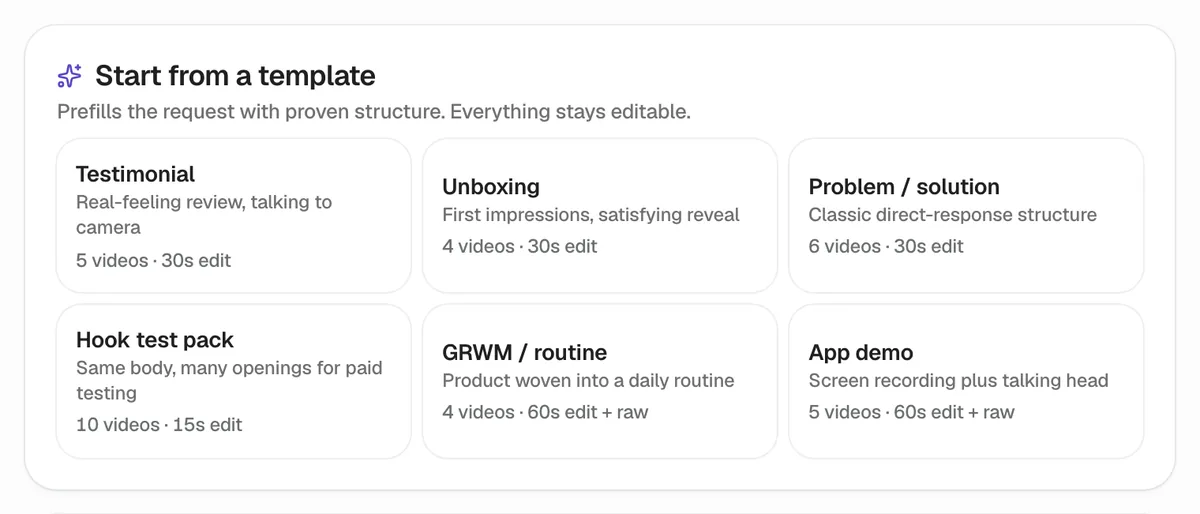
At Ad Army, you submit a request describing your product and what you need. We cast it from our own roster of vetted creators, brief them, contract them and pay them. You review the finished videos, leave timestamped notes, and approve the ones you want, paying a flat price per approved video with full content rights included. Every approved video carries its own tracking code, and the ad builder sends approved videos to Meta as tracked ads, so launching is part of the same workflow. Agencies can run a separate workspace for each client.
 (opens the full-size image in a new tab)
One limitation: creators are anonymous to brands. If you want to build public relationships with named creators, in-house or a creator marketplace will suit you better.