What a UGC video costs in 2026
There is no official price list for UGC, and creators set their own rates. One public reference is Influencer Marketing Hub's guide to UGC creators, published October 14, 2026. It says many creators charge between $150 and $250 per video on average, that a short product video for social can run from $100 to $400, and that top creators may charge $500 to $1,500 or more.
Treat those as starting points, not a quote. The same guide notes that paid usage often adds licensing fees of 25% to 100% or more on top of the base rate.
What actually moves the price
Most of the gap between a cheap quote and an expensive one comes from what is, or isn't, included.
| Cost driver | Why it changes the price | What to ask |
|---|---|---|
| Length | Longer videos take more scripting, filming and editing | Is the price for 15, 30 or 60 seconds? |
| Editing | Raw clips and a finished, captioned ad are different products | Do I get an edited ad or footage I have to cut? |
| Hook variations | Each extra opening is more filming and more edits | How many hooks are included? |
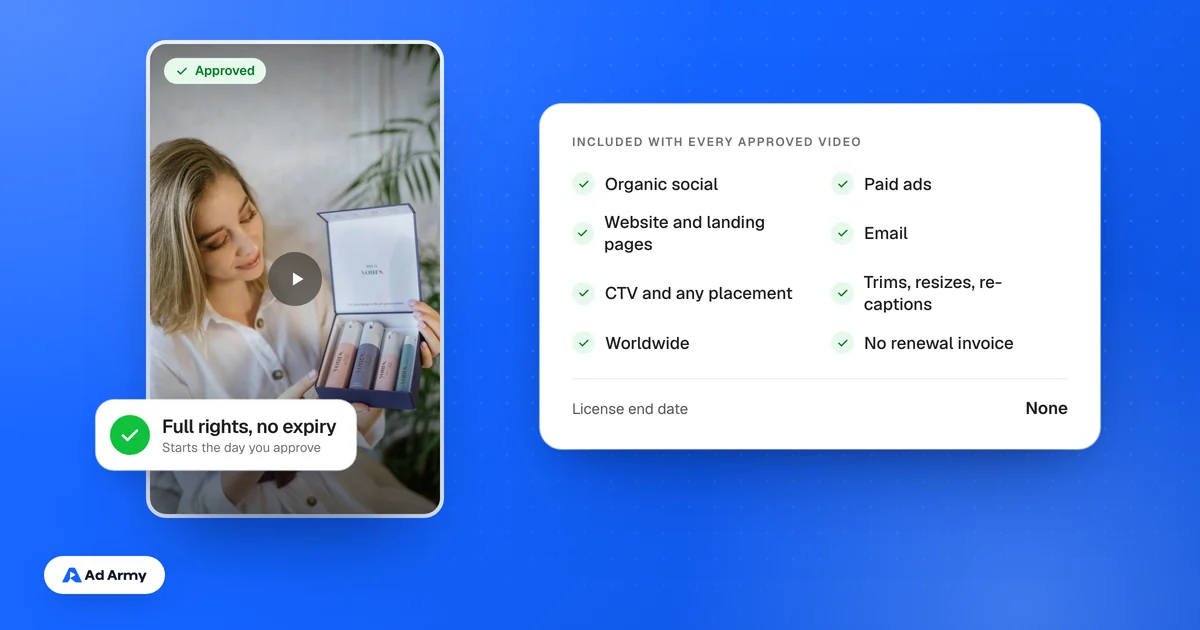
| Usage rights | Paid ads and long terms are often licensed separately | Can I run it as a paid ad, and for how long? |
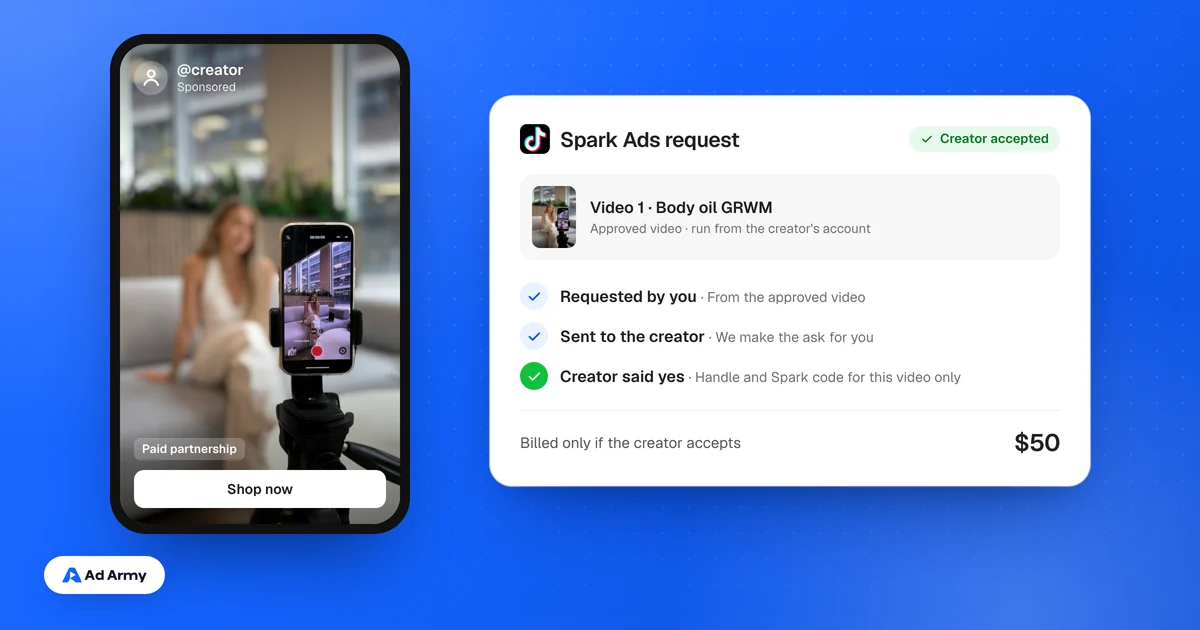
| Whitelisting or Spark Ads | Running ads from the creator's handle needs their consent | Is it priced per video, per month or per creator? |
| Raw footage | Gives your editors more to work with later | Are raw clips included or extra? |
| Revisions | Extra rounds cost the creator time | How many rounds, and what happens after that? |
| Product and shipping | You still pay to get the product to the creator | Who pays when a shipped product never becomes a video? |
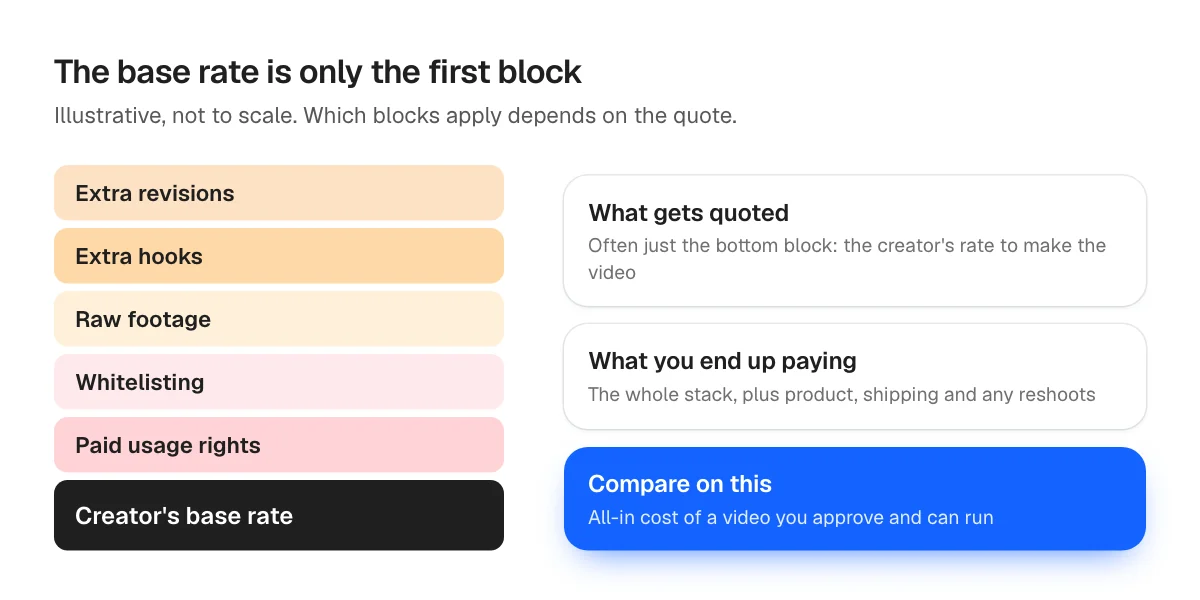
The creator's rate vs your real cost per video
The creator's rate is what they charge to make the video. Your real cost is everything you spend divided by the videos you can actually run.
That difference matters most in two places. First, rights: a cheap video licensed only for organic posts may need a second payment the moment you want to run it as an ad. Our guide to UGC usage rights and how licenses expire covers what to check. Second, misses: a video that comes back off brief and never runs still sits in your total, so a low rate with a high miss rate is not cheap.
If you are comparing subscriptions, service fees and commissions as well as rates, our breakdown of UGC pricing models and hidden fees walks through the formula.
Compare two quotes the right way
The example below is illustrative, not market data. It shows why the headline number misleads.
| Item | Quote A | Quote B |
|---|---|---|
| Headline price per video | Lower | Higher |
| Paid ad rights | Extra, for a set term | Included, no expiry |
| Hooks per video | One | Three |
| Revisions | One round | Until approved |
| Paid only for approved videos | No | Yes |
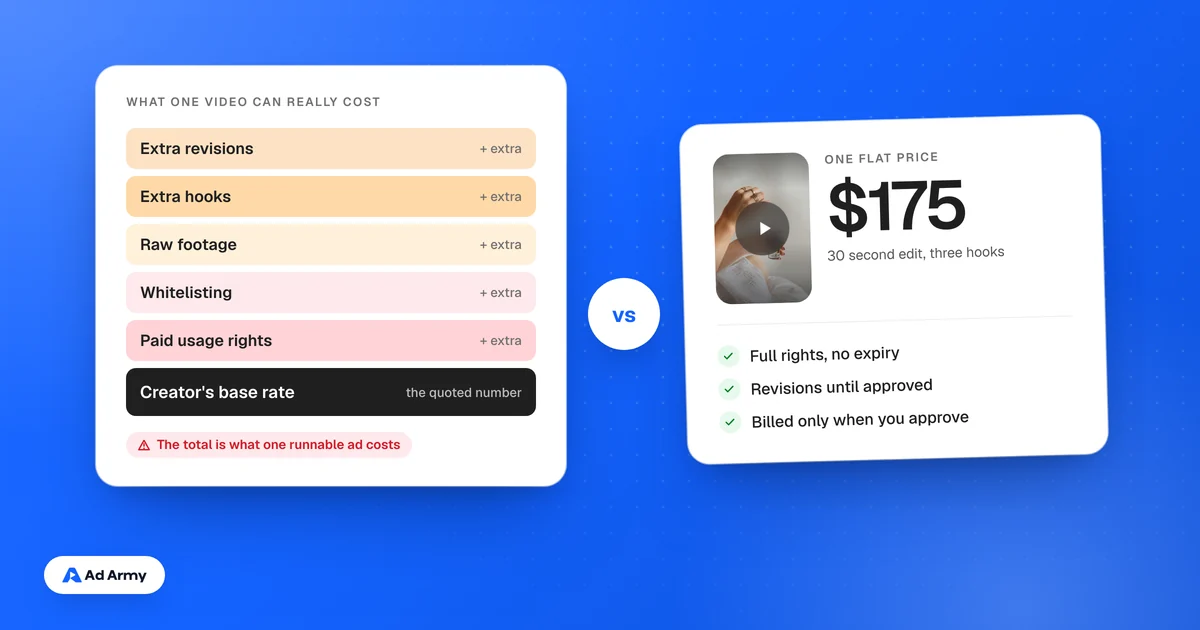
Quote A looks cheaper on the first line. Add a paid-usage license, a second hook and a reshoot for one video that missed, and the cost per runnable ad can end up higher than Quote B. Put every quote into the same table before you decide.
Budget for a batch, not a single video
One video rarely tells you much. Paid social works by testing several openings and angles, keeping the winners and replacing the rest, so budget for a batch. A simple way to set it: decide how many concepts you want to test this month, multiply by the hooks per concept, and price that against the all-in cost per approved video from your quotes. Then leave room for the misses that never run.
This is also where the format choice matters. A single 30 second video filmed with three different hooks gives you three test variations from one shoot, which can cost less than three separate videos. Ask each provider how they handle hook variations before you compare totals.
Checklist before you accept a quote
- The price is for a stated length and an edited, captioned video (or you know it is raw footage)
- Paid ad use is included, and you know for how long and where
- Whitelisting or Spark Ads is priced, and you know whether you pay when the creator declines
- The number of hooks and revision rounds is written down
- You know when you are charged: at order, at delivery or at approval
- Product, shipping and any platform fees are in your total
How Ad Army prices a video
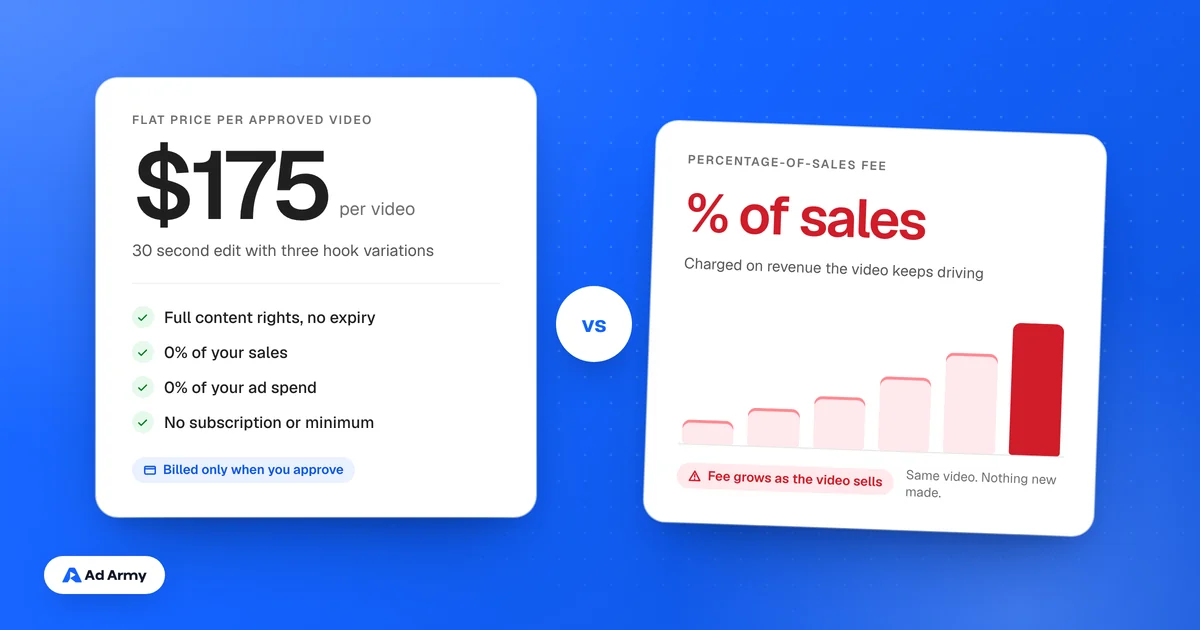
Ad Army charges one flat price per approved video, and the price already includes editing, captions, music and full content rights with no expiry: $125 for a 15 second edit, $175 for a 30 second edit with three hook variations, and $260 for a 60 second edit plus raw footage.
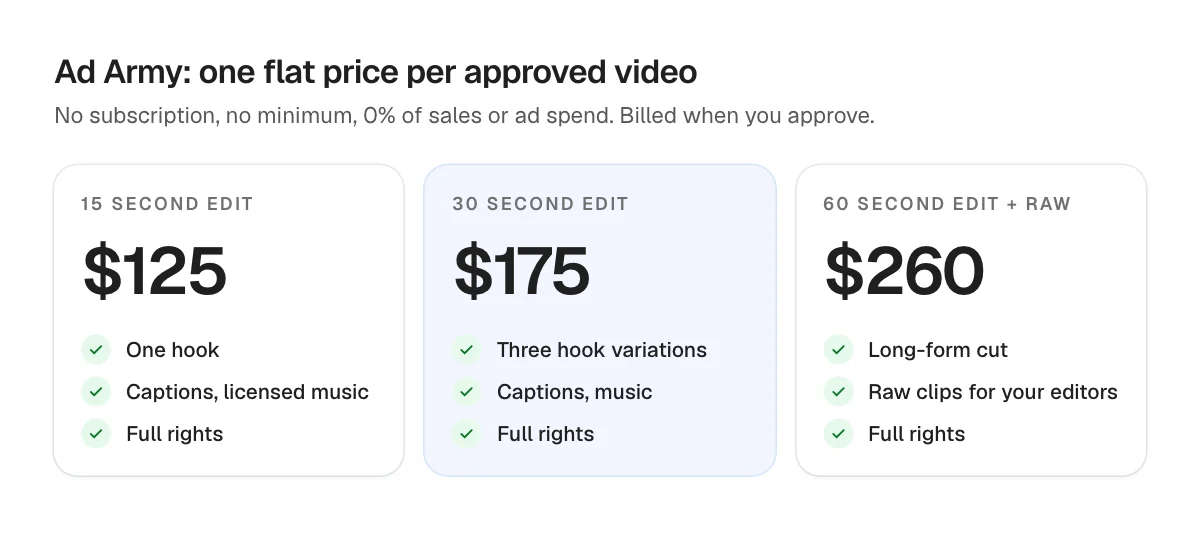
There is no subscription and no minimum, and we take 0% of your sales or ad spend. You pay nothing when you order; each video is billed when you approve it, and revisions continue until you do. The one optional add-on is Spark Ads or whitelisting at $50 per video, billed only if the creator says yes. If you plan to run creator videos from the creator's own handle, read what whitelisting and Spark Ads cost and why first.