Two different ways to pay for creator video
"UGC" covers two arrangements that are easy to blur together.
| Item | Flat fee per video | Commission on sales |
|---|---|---|
| What you pay for | A finished video | Sales the content drives |
| When the cost is set | When you agree the price | Every time a sale is credited |
| Who distributes it | Usually you, through your ads | Usually the creator, on their account |
| Who funds the reach | You pay for the ad spend | The creator's audience, or a boost |
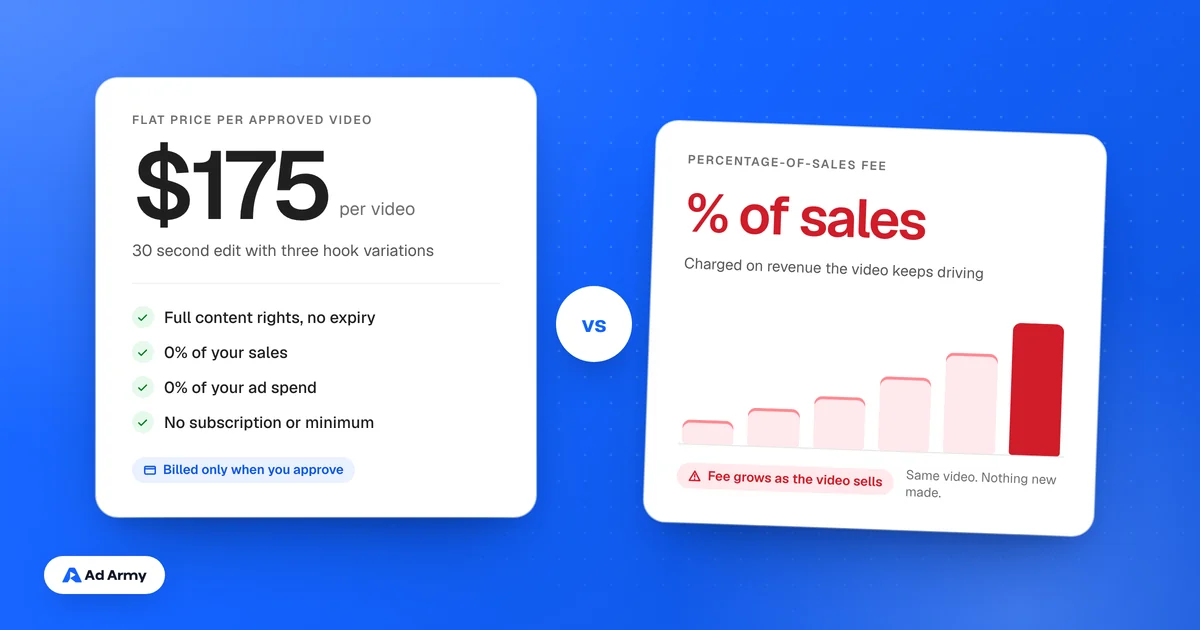
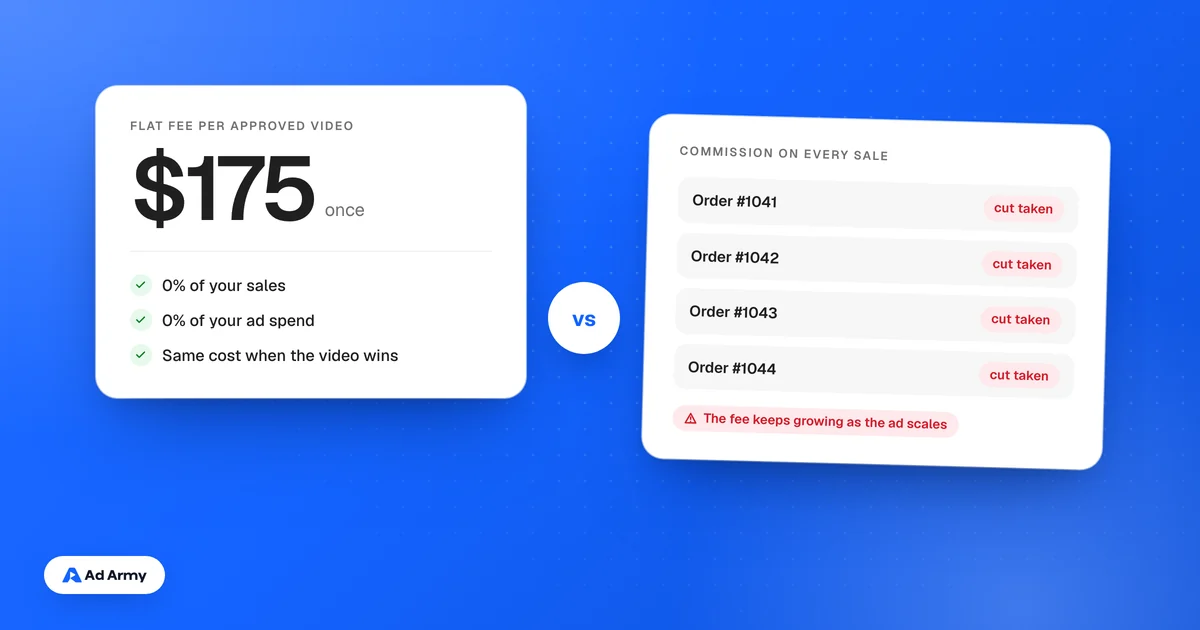
| Cost when a video wins | Unchanged | Grows with sales |
| Best for | Paid social testing and scaling | Affiliate and creator-led selling |
Neither is wrong. They pay for different things, so the question is which one matches how the video will reach people.
How affiliate commission works
TikTok Shop is a clear example of the commission model. Its seller guide to setting up affiliate collaborations, dated July 16, 2026, says sellers set the commission rate for open collaborations, where any eligible creator can promote a product, and for target collaborations with invited creators, in a range of 1% to 80%. A target rate takes priority over an open rate, and sellers can optionally set a separate Shop Ads commission rate for orders that come through ads.
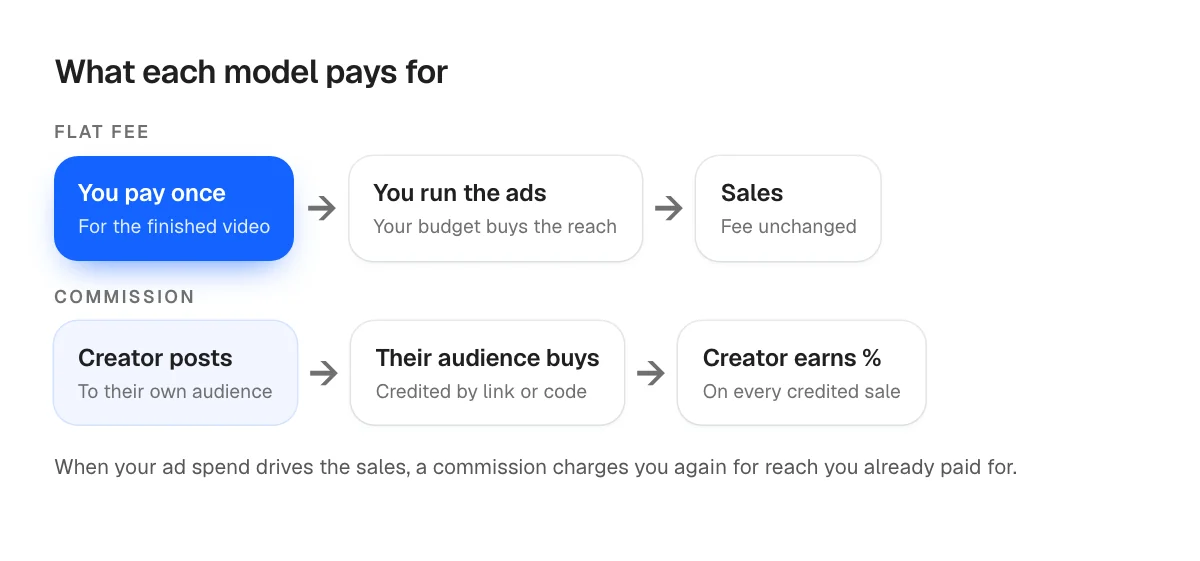
That design makes sense for affiliates: the creator posts on their own account, their audience does the work, and they earn only when it sells. The seller pays for results instead of production.
When commission makes sense
- The creator posts and distributes the content to their own audience
- You don't plan to put significant ad spend behind it
- You want many creators trying your product with little upfront cost
- You can measure which sales came from which creator
The catch is measurement. A commission is only fair if both sides trust how sales are credited, so check which clicks, codes or links count, and for how long after a view a sale still counts. On a platform with its own shop, that tracking is usually built in. Off platform, you may need discount codes or tracked links per creator.
When a flat fee is the better deal
Commission gets awkward once you run the video as your own ad. TikTok Shop shows the overlap directly: orders that come through ads still earn creators a commission, at the Shop Ads rate if you set one or the standard rate if you don't. You are now paying for the reach, and the sales come from your budget. A percentage of those sales means the better the ad performs, the more you pay for a video that has already been made.
A flat fee keeps production and media separate: you pay once for the video, then every dollar of ad spend goes to reach. It also makes budgeting simple. You know the cost of a test batch before it starts, and a winner doesn't send you a bigger bill next month. If a creator also posts the video to their own audience, you can still pay a commission on those sales alone, as long as the agreement says which sales count. This is the same logic as the percentage-of-spend fees covered in our breakdown of UGC pricing models and hidden fees.
Model it before you choose
Run the numbers with your realistic upside, not this month's spend. These numbers are an illustrative example, not market data.
| Monthly sales credited to one ad | Flat fee video | 10% commission |
|---|---|---|
| $2,000 | One fixed fee | $200 per month |
| $10,000 | One fixed fee | $1,000 per month |
| $50,000 | One fixed fee | $5,000 per month |
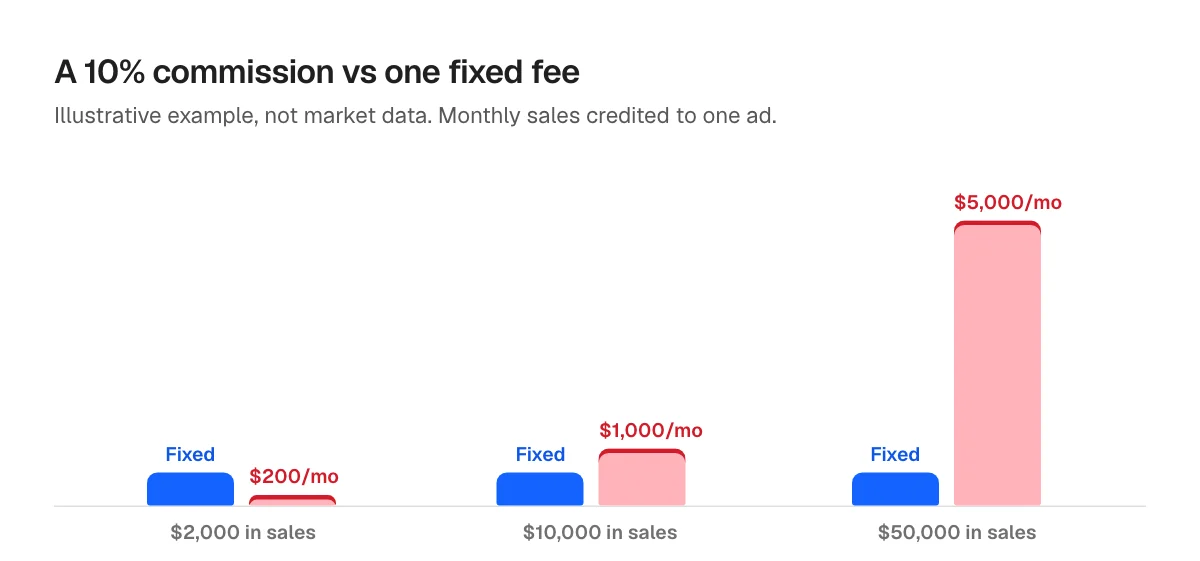
At low sales, commission can be cheaper. Over six months at $10,000 a month, the same ad would cost $6,000 in commission against one fee. Once an ad scales, the percentage keeps running for as long as the ad does. Our guide to how many UGC videos you need for creative testing explains why testing is built to find the few videos worth scaling, and scaling is exactly where a percentage costs the most.
Spot a sales cut in the terms
- Does the provider take any percentage of sales, revenue or orders?
- Does it take a percentage of ad spend?
- Is any part of the fee tied to "performance", and how is that measured?
- Does the fee continue for as long as the video runs?
- Do you need to share store or ad account data so a cut can be calculated?
- Is the per-video price the whole price?
Ask for the answers in writing. If any fee grows with your sales, model it at your best case.
How Ad Army prices
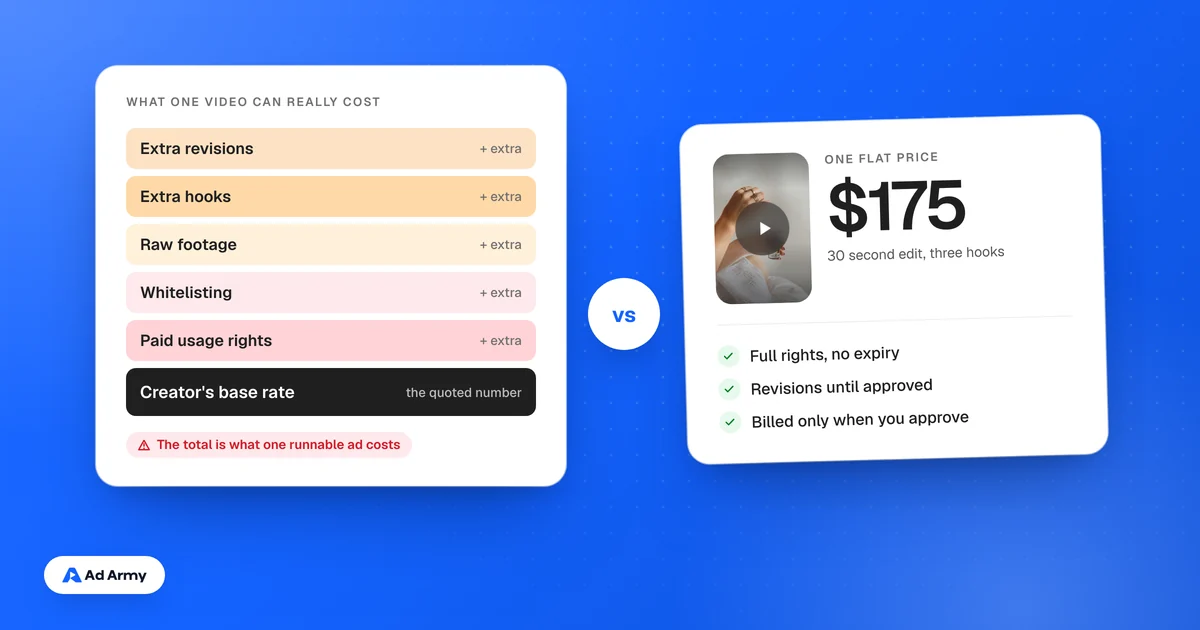
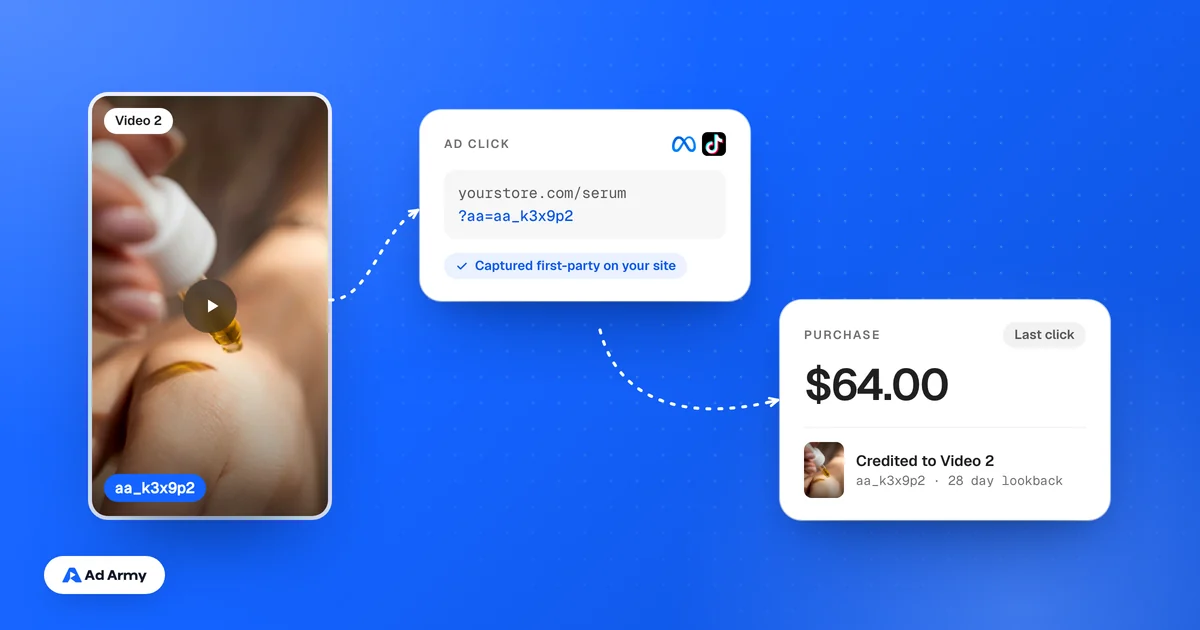
Ad Army uses a flat fee per approved video. Each video is one price, with editing and full content rights included, and we take 0% of your sales and 0% of your ad spend. There is no subscription and no minimum, and nothing is charged until you approve a video. If you want to see which video drove a sale, every approved video carries its own code for last-click attribution, without a cut of the revenue.