Three ways to get UGC made
Most brands end up choosing between three setups. They differ less in the videos than in who does the work around them.
| Item | Freelance creators, direct | Self-serve platform | Agency or managed service |
|---|---|---|---|
| Who finds creators | You | You, from a marketplace | The agency |
| Who writes the brief | You | You | Usually the agency, from your request |
| Who chases late drafts | You | You, with platform tools | The agency |
| Who edits into ads | You or the creator | Varies | Usually the agency |
| Rights paperwork | You draft it | Platform terms | Agency terms |
| How you pay | Per creator, per deal | Platform pricing plus creator fees | Agency pricing |
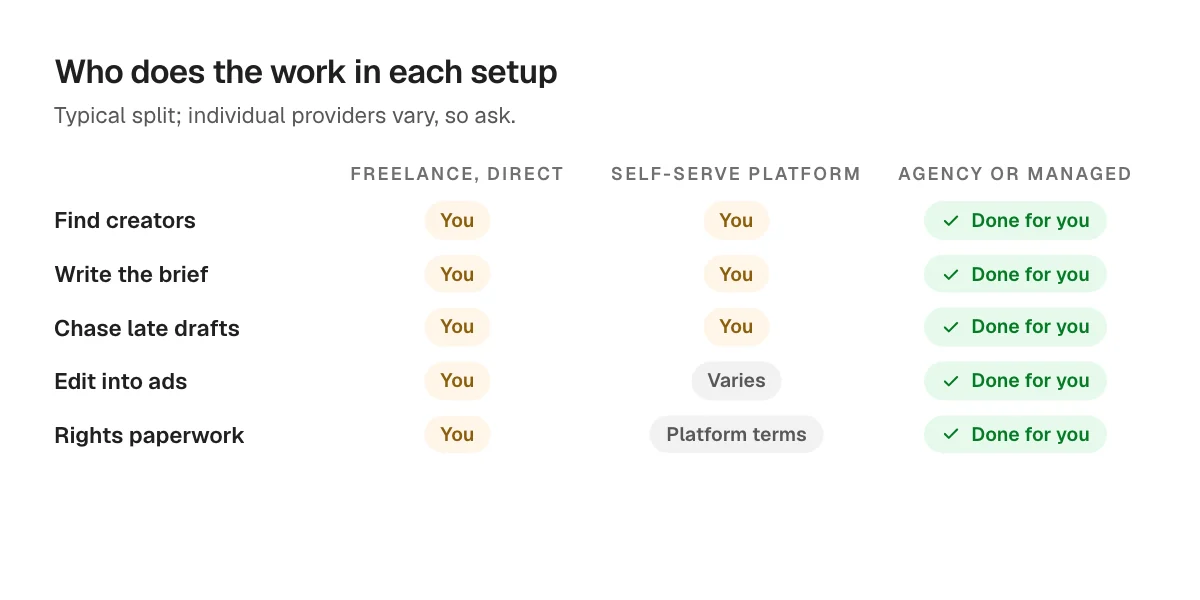
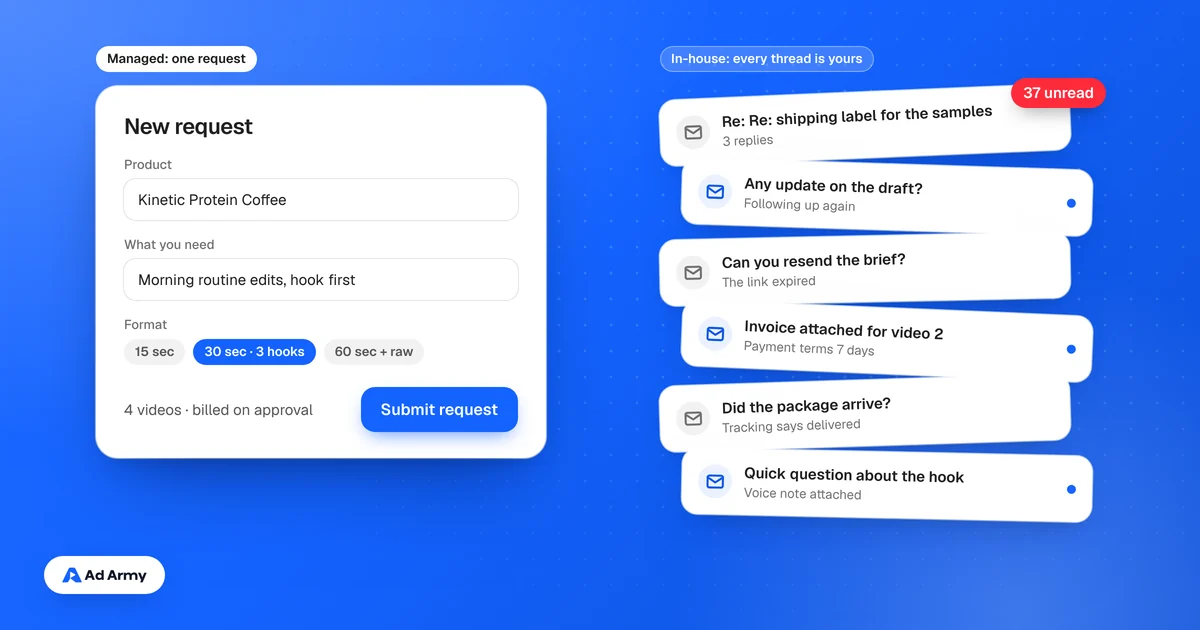
Self-serve platforms sit in the middle. They make finding creators and paying them easier, but the brief, the review and the chasing usually stay with you. If your main problem is finding creators, a platform can be enough. If your main problem is time, it usually isn't.
The same goes for getting ads for TikTok or Reels specifically. The platform doesn't change the work: someone still has to cast, brief, review and edit. What changes is the format you ask for, and whether you also want to run the ad from the creator's handle, which always needs the creator's permission.
What hiring freelancers directly involves
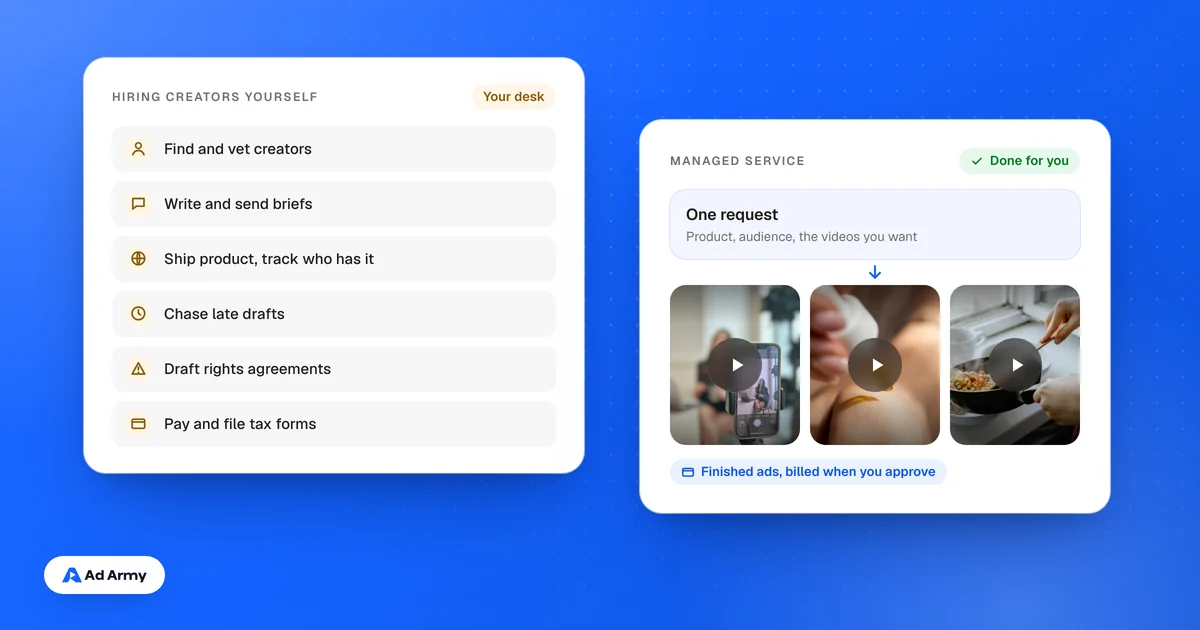
Going direct gives you the most control and often the lowest rate per video. It also makes you the production manager. The work usually includes:
- Finding creators whose style fits, and checking they deliver on time
- Writing a brief that can't be misread, and agreeing on revisions
- Shipping product and tracking who has it
- Drafting an agreement that covers rights and disclosure
- Reviewing drafts, sending notes and chasing the ones that go quiet
- Paying each creator and keeping tax records
Two pieces of paperwork catch people out. Under US copyright law, a commissioned video is not automatically yours: the Copyright Office's Circular 30 explains that a commissioned work counts as made for hire only in specific categories and with a written agreement signed by both parties, so you need the rights spelled out in writing. And paying US creators as contractors can mean filing Form 1099-NEC with the IRS for those paid above the IRS reporting threshold. Ask your accountant how the rules apply to you.
If creators keep missing deadlines, our guide to what to do when UGC creators ghost you covers how to handle missed deadlines.
What an agency is really charging for
An agency's price includes the creator's fee plus the management work above. Before you compare, separate the two:
- Casting and contracting: someone else finds, vets and signs the creators
- Briefing and quality control: drafts are checked before they reach you
- Replacement risk: if a creator drops out, finding another is the agency's problem
- Editing: you get ads, not a folder of clips
- Rights: one set of terms instead of one per creator
What you give up is direct contact. Some agencies keep creators at arm's length, so if building long-term relationships with named creators matters to your brand, that is a real cost.
The costs people forget on each side
- Freelance: your team's hours for sourcing, briefing, chasing and paying
- Freelance: product shipped to creators who never deliver
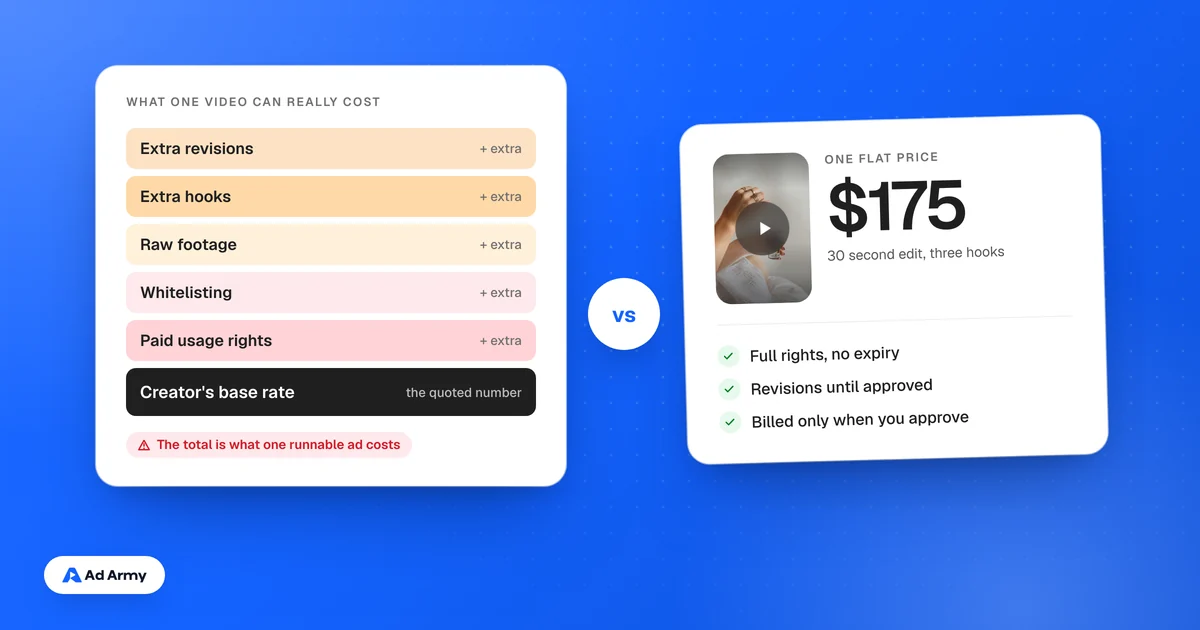
- Freelance: separate fees for paid usage, whitelisting and extra revisions
- Agency: subscriptions, minimums or retainers you pay in slow months
- Agency: any percentage of your sales or ad spend
- Both: videos you pay for but can't run
Our comparison of managed UGC vs managing creators in-house includes a simple way to estimate the hours. As an illustration only: 3 hours per video, 10 videos a quarter and a $50 hourly cost is $1,500 of team time on top of the creator fees.
Which one fits your brand
| Your situation | Usually the better fit |
|---|---|
| You need 1 to 3 videos and have a marketer with spare time | Freelance creators |
| You want long-term relationships with named creators | Freelance creators |
| You need a steady flow of ads for testing | Agency or managed service |
| Nobody on the team owns creator management | Agency or managed service |
| You need TikTok or Meta ads without managing anyone | Agency or managed service |
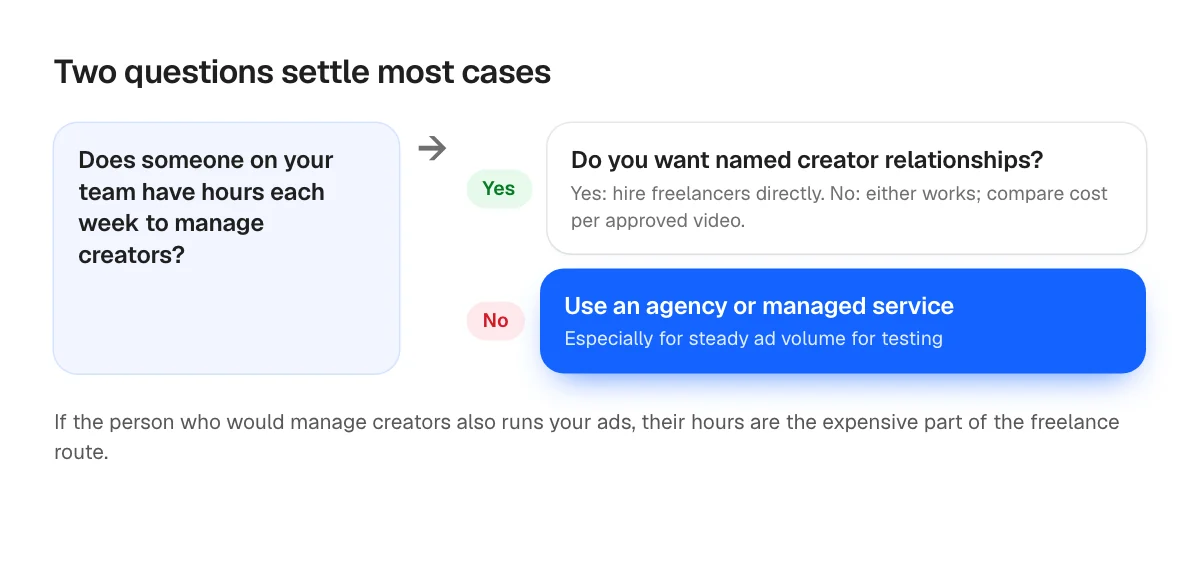
A useful test: if the person who would manage creators is also the person running your ads, their hours are expensive. That is where an agency is most likely to be worth its price.
Whichever you choose, run a small first batch and judge it on the same measure: how many of the videos you paid for actually ran as ads, and what each of those cost you in money and hours. That single number makes a second round of decisions much easier.
Where Ad Army fits
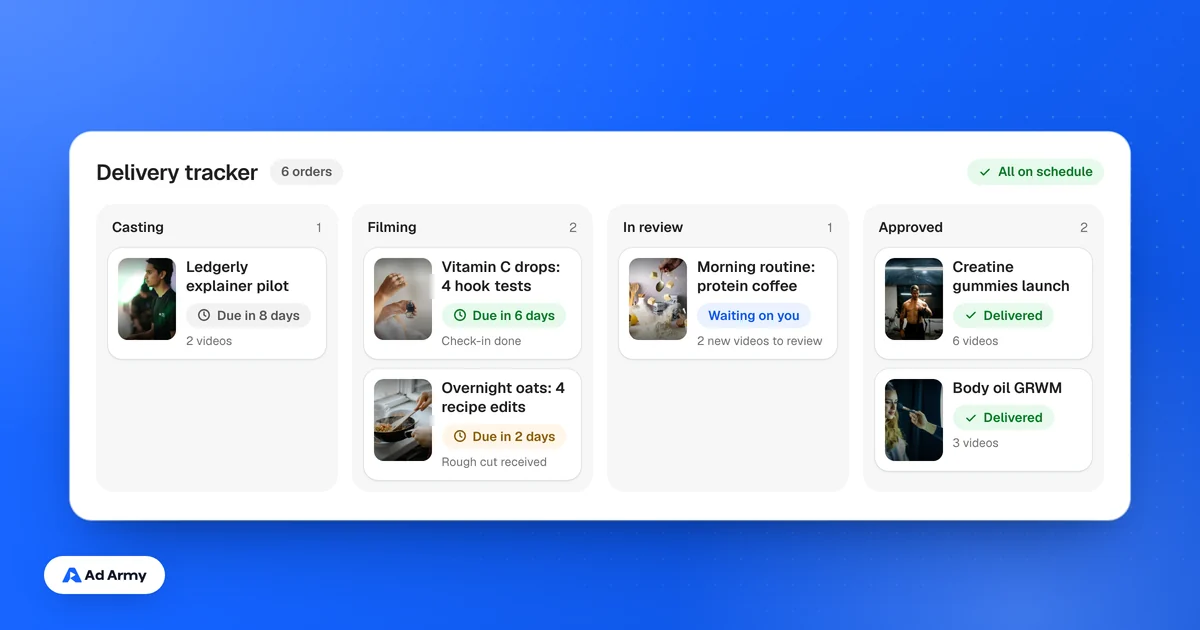
Ad Army is a fully managed UGC service. You submit one request; we cast creators from our own roster, brief, contract and pay them, and send back finished, captioned ads. You leave timestamped notes and revisions continue until you approve. Each video is a flat price, billed only when you approve it, with full rights included and 0% of your sales or ad spend. Creators stay anonymous to brands, so it is not the right fit if you want to build named creator relationships. See what each format costs.