
What a SaaS team should look for
Software is hard to show in a short ad: nothing to unbox, the value sits behind a login, and buyers usually need a trial or demo first. Five things separate a useful production partner from an expensive one:
- Creators who can talk about work software in plain, believable words.
- Product footage in the edit. Most SaaS ads cut between a creator and the product, so ask whether the editor will use your own screen recordings.
- A price per usable video. Ask what you pay for a video you approve, and what happens to one you reject.
- Rights that outlast the test. Winners run for months; our guide to UGC usage rights covers the clauses to check.
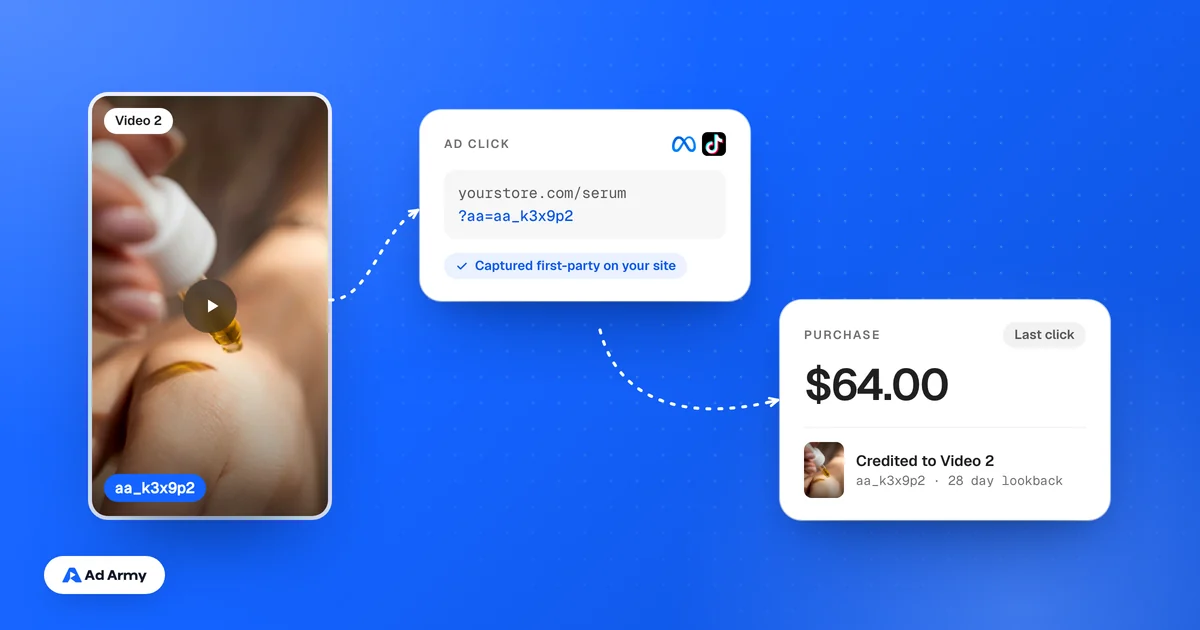
- Tracking per video. Results per ad set can't tell you which hook won.
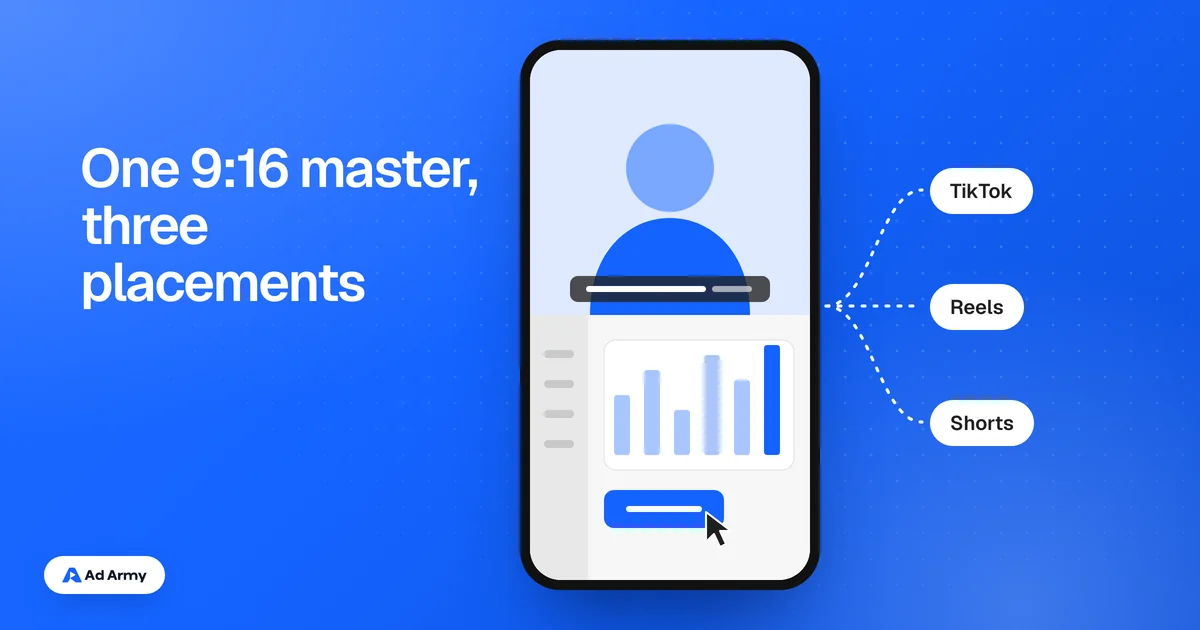
One 9:16 master for TikTok, Reels and Shorts
All three platforms favor vertical video, so plan one 9:16 master per idea and keep text and faces away from the edges each app covers with its own interface.
TikTok in-feed
- Aspect ratio
- 9:16 recommended, minimum 540x960
- Length limit
- Up to 10 minutes
- Safe zone guidance
- Use TikTok's downloadable safe zone templates
Instagram Reels ads
- Aspect ratio
- 9:16, 1440x2560
- Length limit
- Up to 15 minutes
- Safe zone guidance
- Keep 14% top, 35% bottom and 6% each side clear
YouTube Shorts ads
- Aspect ratio
- 9:16 best suited
- Length limit
- Up to 3 minutes; only the first 60 seconds play in the Shorts feed
- Safe zone guidance
- CTA button timing varies by campaign type
| Platform | Aspect ratio | Length limit | Safe zone guidance |
|---|---|---|---|
| TikTok in-feed | 9:16 recommended, minimum 540x960 | Up to 10 minutes | Use TikTok's downloadable safe zone templates |
| Instagram Reels ads | 9:16, 1440x2560 | Up to 15 minutes | Keep 14% top, 35% bottom and 6% each side clear |
| YouTube Shorts ads | 9:16 best suited | Up to 3 minutes; only the first 60 seconds play in the Shorts feed | CTA button timing varies by campaign type |
Sources: TikTok video ad specifications, Meta's Instagram Reels ad specs and Google's Shorts ads asset specs, checked 2026-10-16.
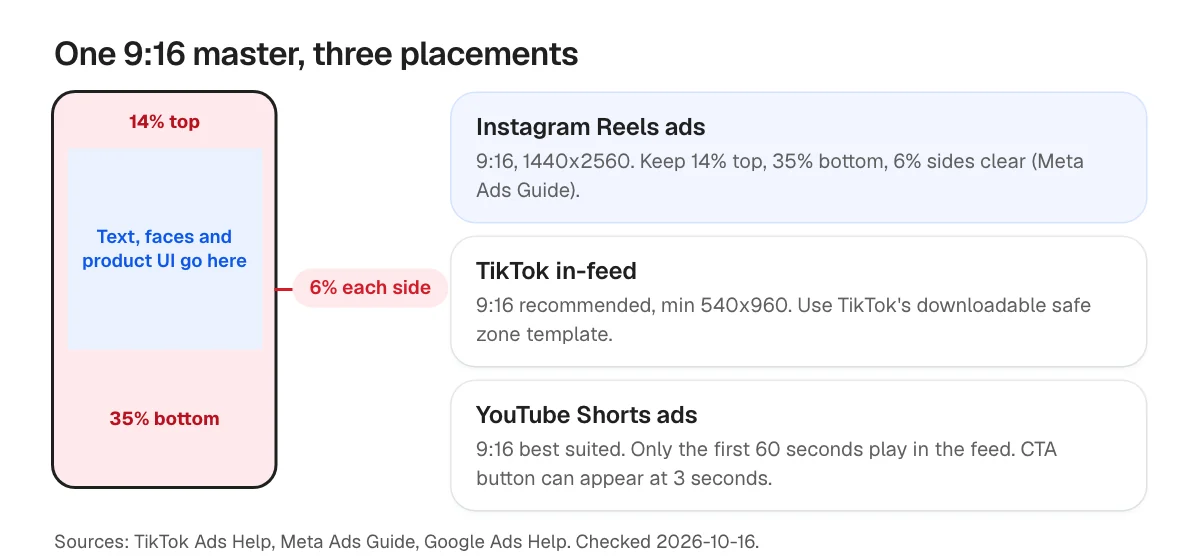
The limits are generous; the guidance is shorter. Google recommends 10 to 30 seconds for Shorts ads that ask for an action. Meta's Reels ads page says Reels default to sound on and recommends video with audio. So captions and music both matter: sound-on viewers hear the voiceover and track, sound-off viewers need captions to follow the screen. Ask every provider whether both are in the price.
Four formats that work for software
Google's 2024 post on Shorts ads says the strongest ones feel native, authentic and casual, and names Postman Flows, a developer tool, among its examples. Four formats fit that for SaaS:
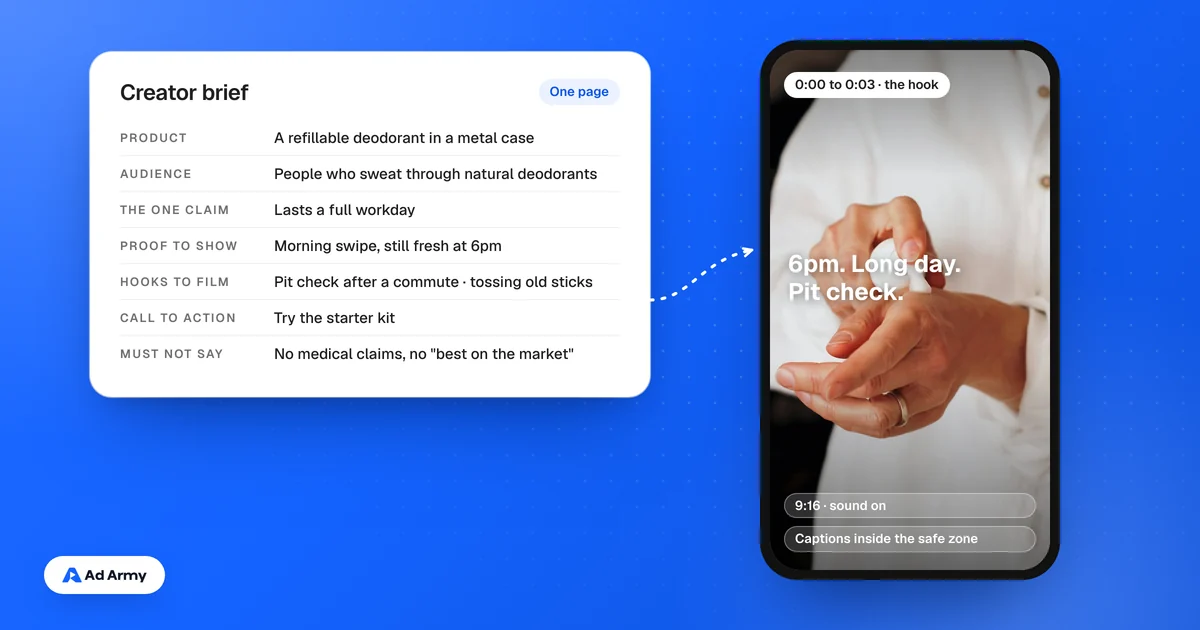
- Creator talking head plus screen recording. The creator explains the problem, then the edit cuts to the product doing the job. Send your own product footage or screen recordings with the brief for the editor to use.
- Problem and solution. Open on the frustration (the broken spreadsheet, the lost handoff), then show the fix.
- Quick demo. One feature, one outcome, shown fast.
- Founder or user story. Why someone built or switched to the product, ending on a specific result.
Our guide on how to brief UGC creators for paid social has a one-page template; for software, add the exact screens to show and the claims you can make.
A creative testing ladder: concept, hook, creator, offer
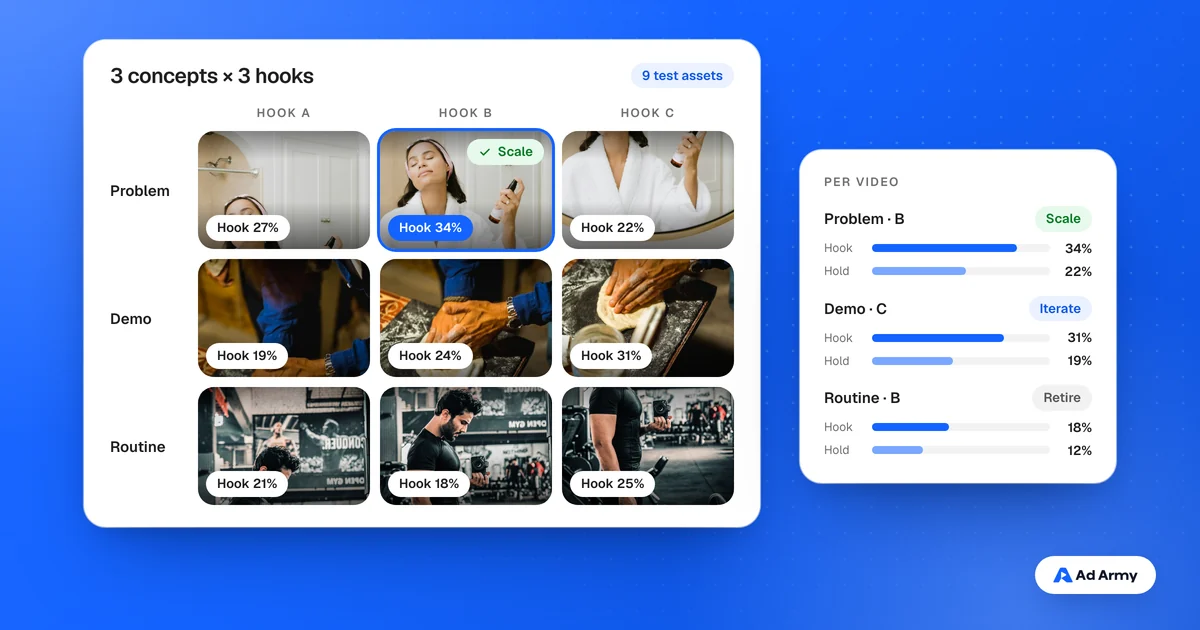
Change one thing per round so you know what caused the result.
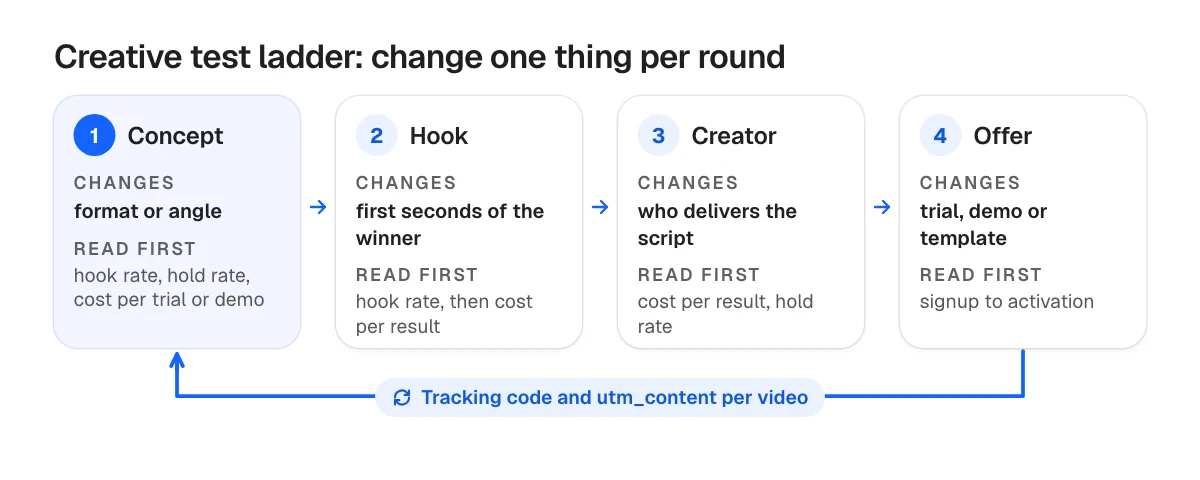
Concept
- What changes
- The format or angle
- What stays fixed
- Creator and offer
- Read first
- Hook rate, hold rate, cost per trial or demo
Hook
- What changes
- The opening seconds of the winning concept
- What stays fixed
- Body, creator and offer
- Read first
- Hook rate, then cost per result
Creator
- What changes
- Who delivers the winning script
- What stays fixed
- Concept, hook and offer
- Read first
- Cost per result and hold rate
Offer
- What changes
- Free trial, demo or template
- What stays fixed
- The winning video
- Read first
- Signup to activation, not just clicks
| Round | What changes | What stays fixed | Read first |
|---|---|---|---|
| Concept | The format or angle | Creator and offer | Hook rate, hold rate, cost per trial or demo |
| Hook | The opening seconds of the winning concept | Body, creator and offer | Hook rate, then cost per result |
| Creator | Who delivers the winning script | Concept, hook and offer | Cost per result and hold rate |
| Offer | Free trial, demo or template | The winning video | Signup to activation, not just clicks |
Batch size depends on budget and test length; our guide to how many UGC videos you need for creative testing covers sizing. We found no official Meta number of ads per ad set, so treat fixed numbers as rules of thumb. Optimize to the deepest event you can pass back reliably: a trial start, a booked demo or a qualified signup.
Measure each video, not just the account
Three setups make per-video results trustworthy:
- Meta Conversions API alongside the Pixel. Meta's deduplication guide says browser and server events only dedupe when the event name and event ID match, within a 48-hour window.
- TikTok Events API alongside the TikTok Pixel. TikTok's Events API guide describes it as a second channel next to the Pixel, set up through a partner, a data partner or a direct integration.
- UTMs read in GA4. Google's UTM guidance says to always set utm_source, utm_medium and utm_campaign, use utm_content to tell creatives apart, and stick to lowercase because values are case sensitive. Give every video and hook its own utm_content value.
Our post on finding which UGC video drove sales walks through the rest.
How to choose a production company
Providers in this space run on very different models. Here is what a SaaS specialist and a per-video managed service each publish.
Focus
- Videodeck
- SaaS and tech brands only, done for you
- Ad Army
- Creator video ads, fully managed
Price
- Videodeck
- $2,000 to $5,000 per video, by plan
- Ad Army
- $125 (15s), $175 (30s), $260 (60s plus raw) per approved video
Rights
- Videodeck
- Full rights to final videos on delivery
- Ad Army
- Full content rights, no expiry
Revisions
- Videodeck
- As many as needed, offered in place of refunds
- Ad Army
- Until you approve
Delivery
- Videodeck
- 5 to 10 business days
- Ad Army
- You set the due date, from 10 days out
Captions and music
- Videodeck
- Music and graphics licensed for marketing use
- Ad Army
- Captions and music included
Reporting
- Videodeck
- Not published
- Ad Army
- Tracking code per video, last-click attribution
| Item | Videodeck | Ad Army |
|---|---|---|
| Focus | SaaS and tech brands only, done for you | Creator video ads, fully managed |
| Price | $2,000 to $5,000 per video, by plan | $125 (15s), $175 (30s), $260 (60s plus raw) per approved video |
| Rights | Full rights to final videos on delivery | Full content rights, no expiry |
| Revisions | As many as needed, offered in place of refunds | Until you approve |
| Delivery | 5 to 10 business days | You set the due date, from 10 days out |
| Captions and music | Music and graphics licensed for marketing use | Captions and music included |
| Reporting | Not published | Tracking code per video, last-click attribution |
Videodeck calls its model a "video as a service solution" for SaaS and tech. Its site lists $5,000 for one video, falling to $2,000 per video on its largest monthly plan. Its model is done-for-you production.
Ad Army casts creators and charges a flat price per approved video, so you pay only for videos you approve. The 30-second video comes with three hook variations, and last-click attribution reports hook rate, hold rate and ROAS per video. You can send product footage or screen recordings with the brief. See our pricing, content rights and attribution pages.
We make Ad Army, so weigh our column accordingly. Competitor details come from public pages as of October 16, 2026; check them before you buy. Ad Army is not affiliated with Videodeck. Spot an error? Email support@adarmy.app.