
What a multi-client setup needs
Most agencies start creator work in one account, with one card, one folder of videos and client feedback scattered across email. That breaks down as the client count grows.
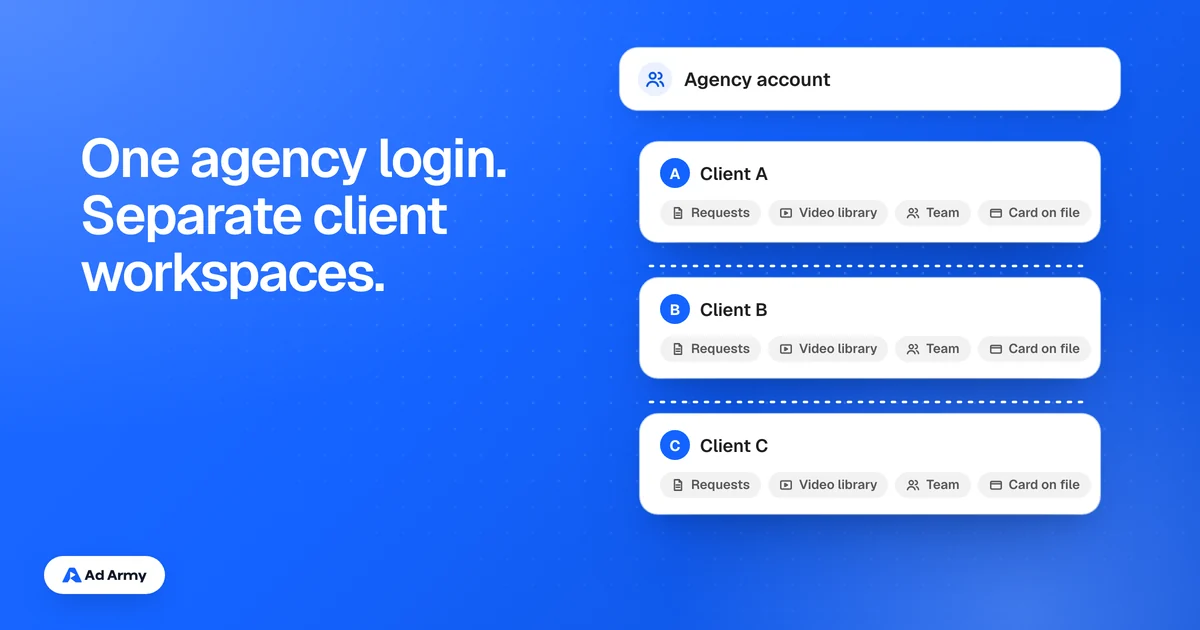
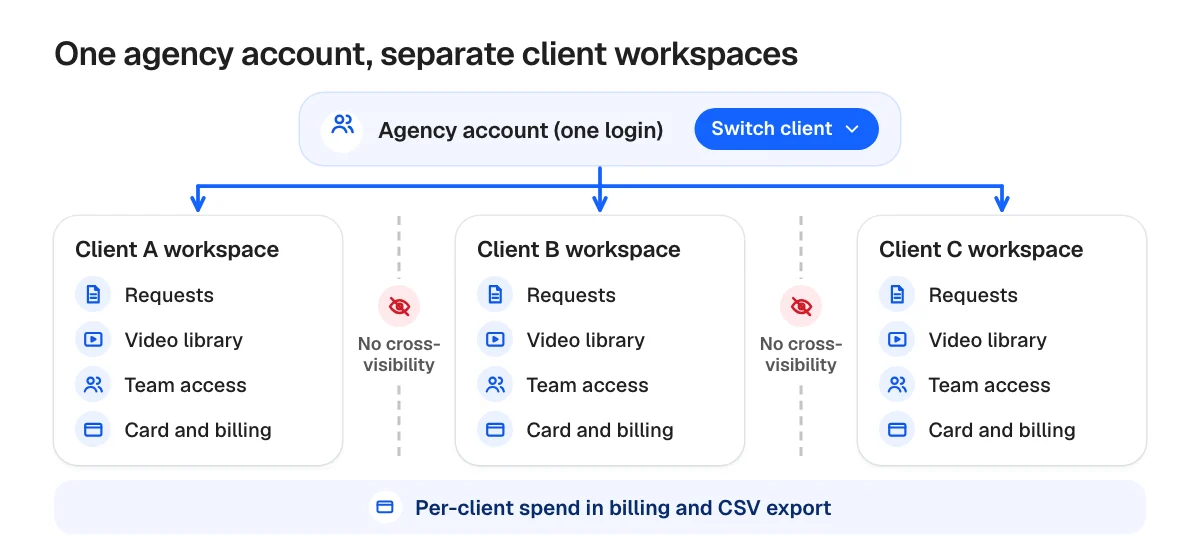
- A workspace per client. Each brand's requests, videos and team access sit apart.
- Billing per client. A separate card or per-client spend report, so rebilling needs no detective work.
- Client review without an account. Your client's stakeholders approve or comment on a link, without seeing other clients or your billing.
- Vetted creators. Someone has already checked creators on camera, so you are not re-auditing applicants per brand.
For the creative side, see our guide on how to brief UGC creators for paid social.
Your options, by model
The table uses what each provider publishes; "not published" means its own pages say nothing, not that the feature is missing.
Influencer software: CreatorIQ, GRIN, Modash, Upfluence
- Who casts, films and edits
- Your team; the software handles discovery, CRM and payments
- Per-client separation
- GRIN's Growth plan lists multiple brands; others not published
- Client review
- Not published
- Billing model
- Plan or platform fee; GRIN and Modash publish prices
- Rights
- Set by your own creator contracts
Software plus agency services: Aspire
- Who casts, films and edits
- Aspire's agency team, using its platform
- Per-client separation
- Not published
- Client review
- Not published
- Billing model
- Not published
- Rights
- Not published
Managed creator infrastructure: Launchpoint
- Who casts, films and edits
- Managed deals scoped on a demo call
- Per-client separation
- One agency account holds each brand's campaigns, per its blog
- Client review
- Approve or reject in Discord, per its blog
- Billing model
- Not published on its site
- Rights
- Not published
Performance and creative agencies: NewForm, Y'all
- Who casts, films and edits
- The agency's team
- Per-client separation
- Not published
- Client review
- Review rounds agreed per engagement (NewForm)
- Billing model
- Quoted by scope
- Rights
- Not published
Freelancers
- Who casts, films and edits
- Each freelancer, or you
- Per-client separation
- Your own folders and spreadsheets
- Client review
- Your own process
- Billing model
- One invoice per freelancer
- Rights
- Whatever each contract says
Ad Army (us)
- Who casts, films and edits
- Ad Army casts vetted creators; you get edited cuts
- Per-client separation
- A workspace per client brand with its own requests, library, team and card
- Client review
- Review link, no account needed, timecoded comments
- Billing model
- Flat price per approved video
- Rights
- The client brand on the order holds full rights
| Option | Who casts, films and edits | Per-client separation | Client review | Billing model | Rights |
|---|---|---|---|---|---|
| Influencer software: CreatorIQ, GRIN, Modash, Upfluence | Your team; the software handles discovery, CRM and payments | GRIN's Growth plan lists multiple brands; others not published | Not published | Plan or platform fee; GRIN and Modash publish prices | Set by your own creator contracts |
| Software plus agency services: Aspire | Aspire's agency team, using its platform | Not published | Not published | Not published | Not published |
| Managed creator infrastructure: Launchpoint | Managed deals scoped on a demo call | One agency account holds each brand's campaigns, per its blog | Approve or reject in Discord, per its blog | Not published on its site | Not published |
| Performance and creative agencies: NewForm, Y'all | The agency's team | Not published | Review rounds agreed per engagement (NewForm) | Quoted by scope | Not published |
| Freelancers | Each freelancer, or you | Your own folders and spreadsheets | Your own process | One invoice per freelancer | Whatever each contract says |
| Ad Army (us) | Ad Army casts vetted creators; you get edited cuts | A workspace per client brand with its own requests, library, team and card | Review link, no account needed, timecoded comments | Flat price per approved video | The client brand on the order holds full rights |
We make Ad Army, so weigh our row accordingly; the others come from the linked pages, retrieved October 16, 2026. For a wider look at UGC providers, see our UGC platforms comparison.
What the software and service providers publish
Influencer software gives your team tools; your team still does the recruiting, briefing, chasing, editing and review. GRIN lists Free ($0 with a 20% wallet fee), Starter ($200 a month), Growth ($500 a month, the plan that lists multiple brands) and Scale ($1,500 a month). Modash lists Essentials at $199 a month and Performance at $499 a month, with Enterprise from $14,700 a year. Upfluence quotes custom prices with a 12 month minimum on annual plans and role-based permissions on every plan. CreatorIQ is demo-only and does not describe how clients are separated.
Software plus services. Aspire describes a managed Agency Services team that runs programs on its platform.
Managed infrastructure. Launchpoint says it takes managed deals only, each scoped on a booked demo call. Its Discord integration post describes one agency account holding each brand's campaigns, creators, content and reporting, with brands able to add their own card for creator costs.
Agencies. NewForm offers creative analytics software, a managed creator program and a full-service creative team, all quoted. Y'all is a DTC performance agency offering UGC creator sourcing and management, whitelisting, video ads and media buying, priced by scope. Neither site mentions white-label work for agencies.
How Ad Army handles client workspaces
We built Ad Army for agencies around the four needs above. Each client brand gets its own workspace with its own requests, video library, team access, and card and billing. You switch between clients from one login.
You send a request in the client's workspace and Ad Army casts vetted creators from its roster. Creators stay anonymous to you and your client, and Ad Army does the chasing. You can share a review link with the client's stakeholders: they approve or leave timecoded comments without creating an account, and they never see your other clients or your billing. Revisions continue until approved.
Pricing is a flat price per approved video: $125 for 15 seconds, $175 for 30 seconds, and $260 for 60 seconds plus raw footage, with no subscription and 0% of sales or ad spend. Our explainer on paying only for approved UGC videos covers how approval billing works.
Rights, rebilling and FTC duties when you order for a client
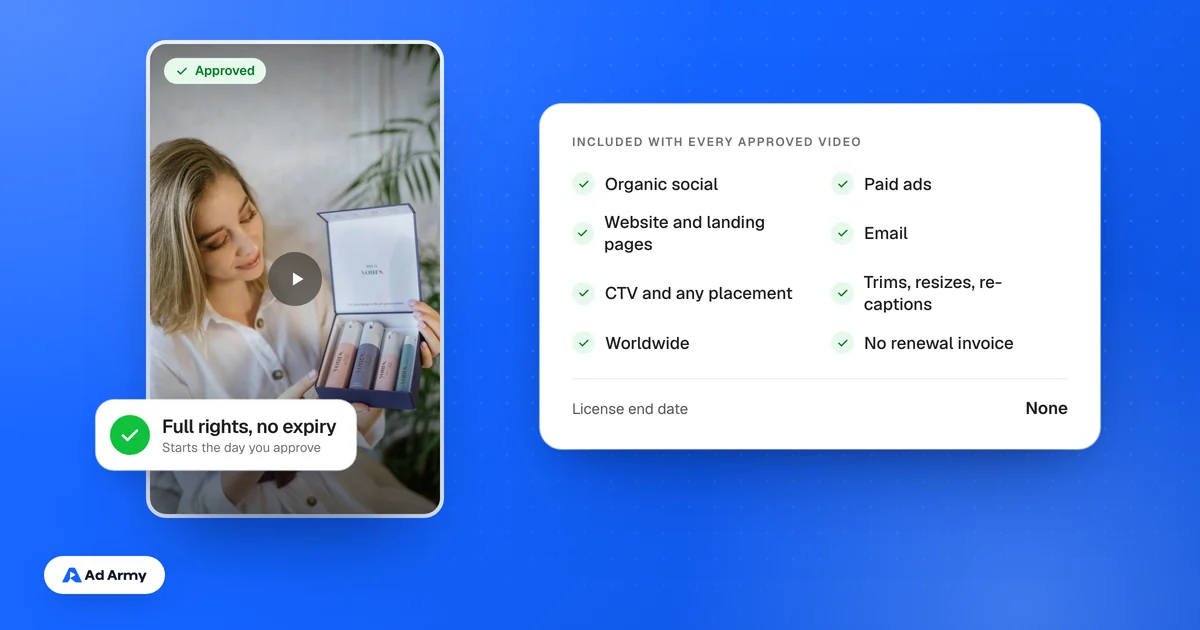
Rights. Ask every provider who ends up holding the rights: your agency or your client. A work made for hire only covers independent contractors' work in nine statutory categories with a signed writing, and a UGC video may or may not fit one of them, so creator contracts often pair it with an assignment, or rely on a license instead. A license grants use within set terms; an assignment transfers ownership. For paid ads, check channels, term, territory, edits, sublicensing and likeness consent. On Ad Army, the client brand named on the order holds full content rights for organic, ads and any placement, with no expiry. Our UGC usage rights guide goes deeper.
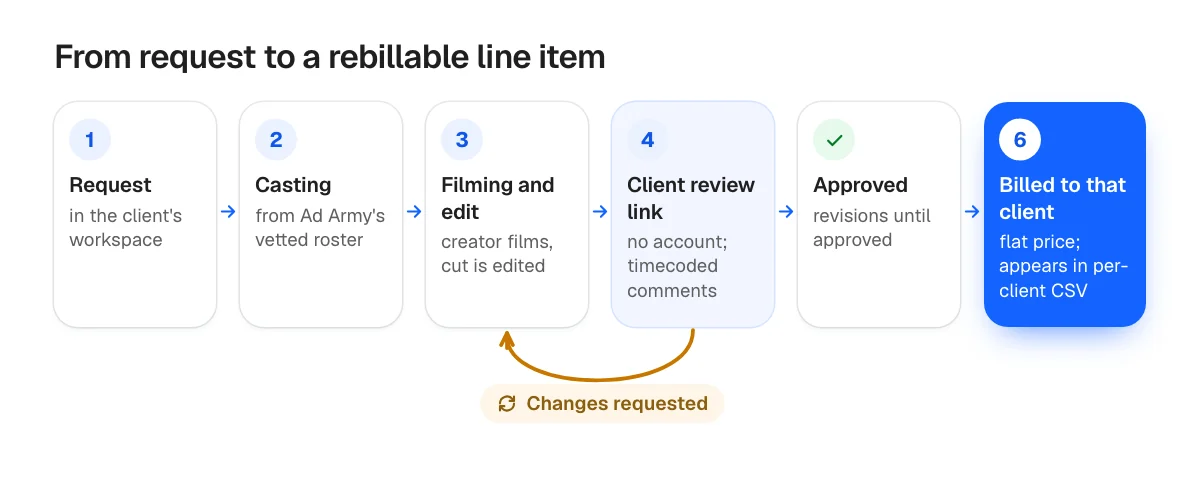
Rebilling. There is no standard markup. Some agencies bill pass-through costs at cost plus a markup kept as agency income, as Parakeeto describes; others, as TrinityP3 argues, pass production through at net cost and show their fee separately. Either way, write it into the client contract. Ad Army shows spend per client in billing and a CSV export.
FTC duties. The FTC's Endorsement Guides Q&A says intermediaries, such as agencies that recruit or pay influencers, can be liable for deceptive endorsements or for missing disclosures of material connections, and should run reasonable programs to train and monitor the people they work with. It also says hiring an outside firm "doesn't relieve you of responsibility under the FTC Act." Pre-approve paid posts, agree on labels, and keep approval records.
Questions to ask any provider
- Does each client get its own workspace, and can one client's team see another's work?
- Can each client have its own card, or at least its own spend report and export?
- Can client stakeholders review without an account, and what do they see?
- Who casts, films and edits, and who vets the creators?
- Is the price per finished video, per creator, a plan fee or a share of spend?
- Who is named as the rights holder: the agency or the client brand? Is it a license or an assignment, and for how long?
- How are revisions handled, and when are you billed?
Still deciding whether to manage creators in-house? See managed UGC vs in-house creator management.